4 layers90 × 60 mm

 CopperPilot/retro-handheld-copperpilot1
An ESP32-S3 game console on one 63 × 80 mm board. 2.4" TFT, 14 buttons, USB-C charging that keeps you playing, and a snap-fit case to print.
Copperpilot retro handheld is an open-source printed circuit board by CopperPilot, from the CopperPilot/retro-handheld-copperpilot repository on GitHub. It is a 4-layer board of 63 × 80 mm with 74 parts on 59 nets, routed with 696 tracks and 67 vias.
It is built around the ESP32-S3-WROOM-1-N8, AP2112K-3.3 and USBLC6-2SC6, with the AO3401A, SM10B-GHS-TB(LF)(SN) and MBR0520 among its other parts. Its parts include 30 resistors, 17 switches, 15 capacitors, 4 ICs and 3 diodes. It belongs with the retro computing and games boards and the ESP32 boards of this library.







The CopperPilot Retro Handheld is an ultra-compact, single-board retro handheld console design built on a 4-layer FR-4 PCB (63.00 mm x 80.00 mm) with a parametric snap-fit enclosure. Built around an Espressif ESP32-S3 dual-core microcontroller, the hardware features a 2.4-inch 320x240 ILI9341 SPI color TFT display, 14 responsive gameplay and shoulder pushbuttons, integrated USB-C charging and native USB-OTG/JTAG programming, automatic load-sharing battery power management for uninterrupted gameplay while charging, and a removable 1000 mAh Li-Po cell.
Project status: this repository contains the hardware (schematic, PCB, enclosure CAD, and manufacturing outputs) only. There is no firmware yet, so no frame rates, emulator compatibility, or battery runtime have been measured on this board.
| Front Face & Controls | Rear Shell & Grip Channels |
|---|---|
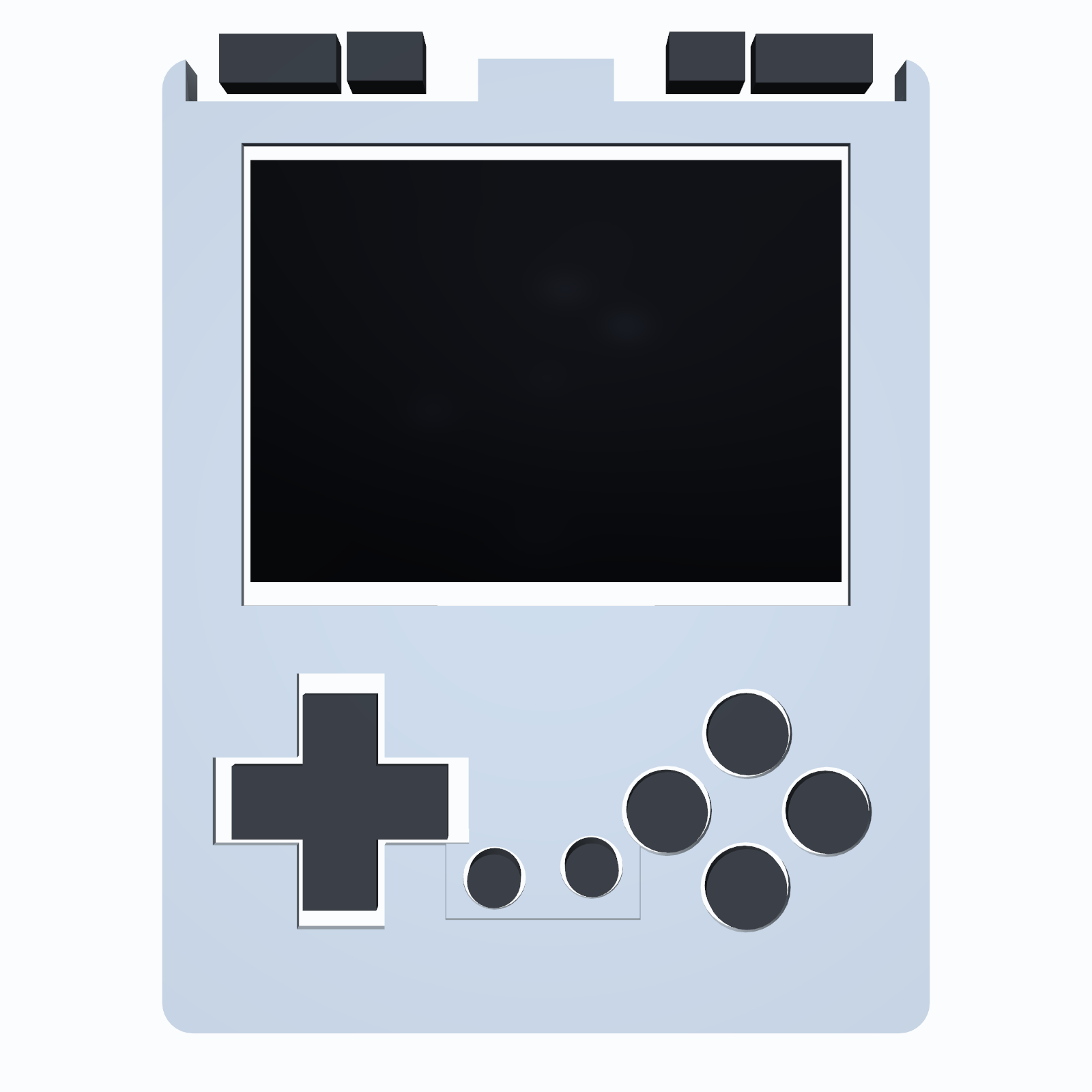 | 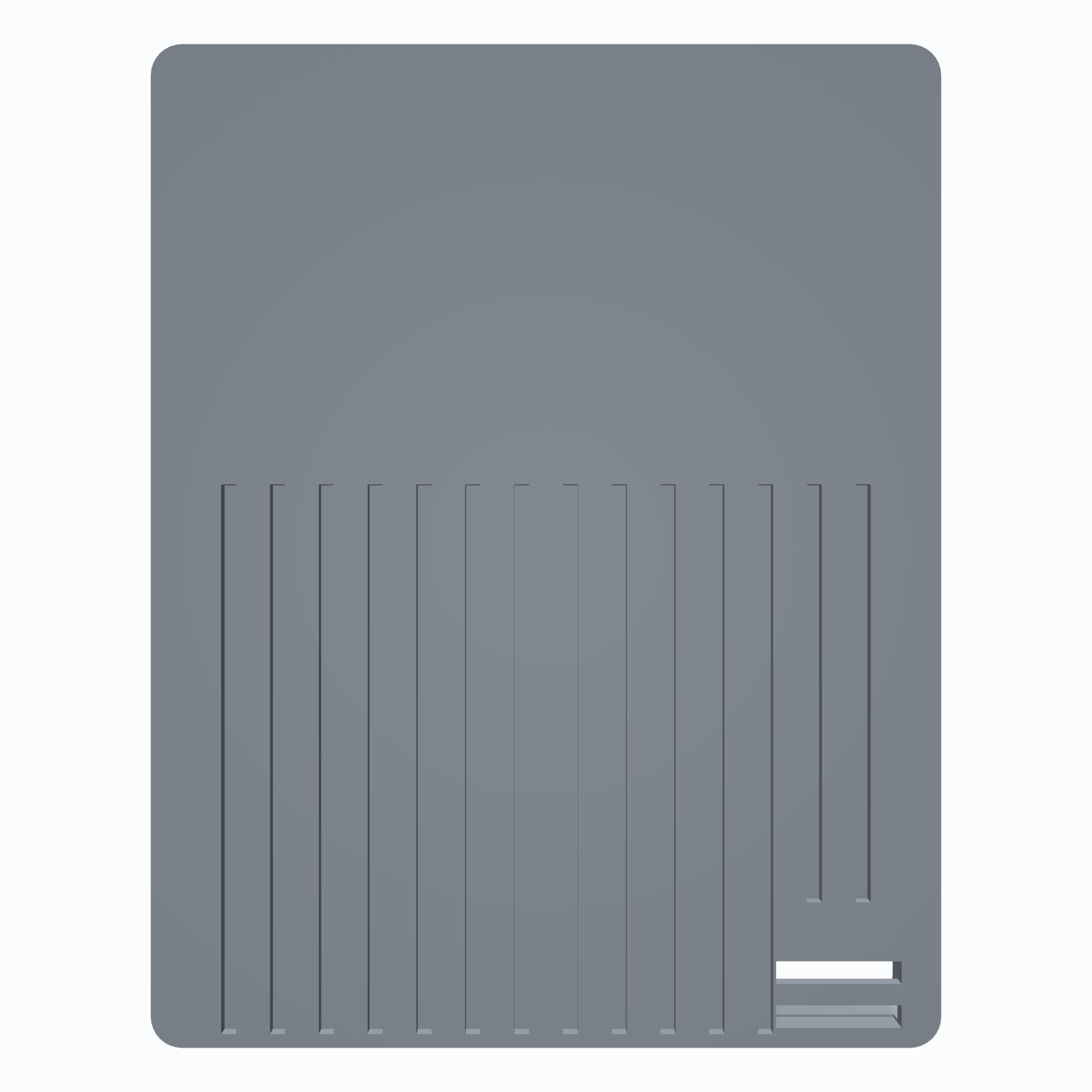 |
| Front bezel, display window & keycaps | Rear grooved shell & battery hatch |
| 3/4 Isometric View | Exploded Subsystem Assembly |
|---|---|
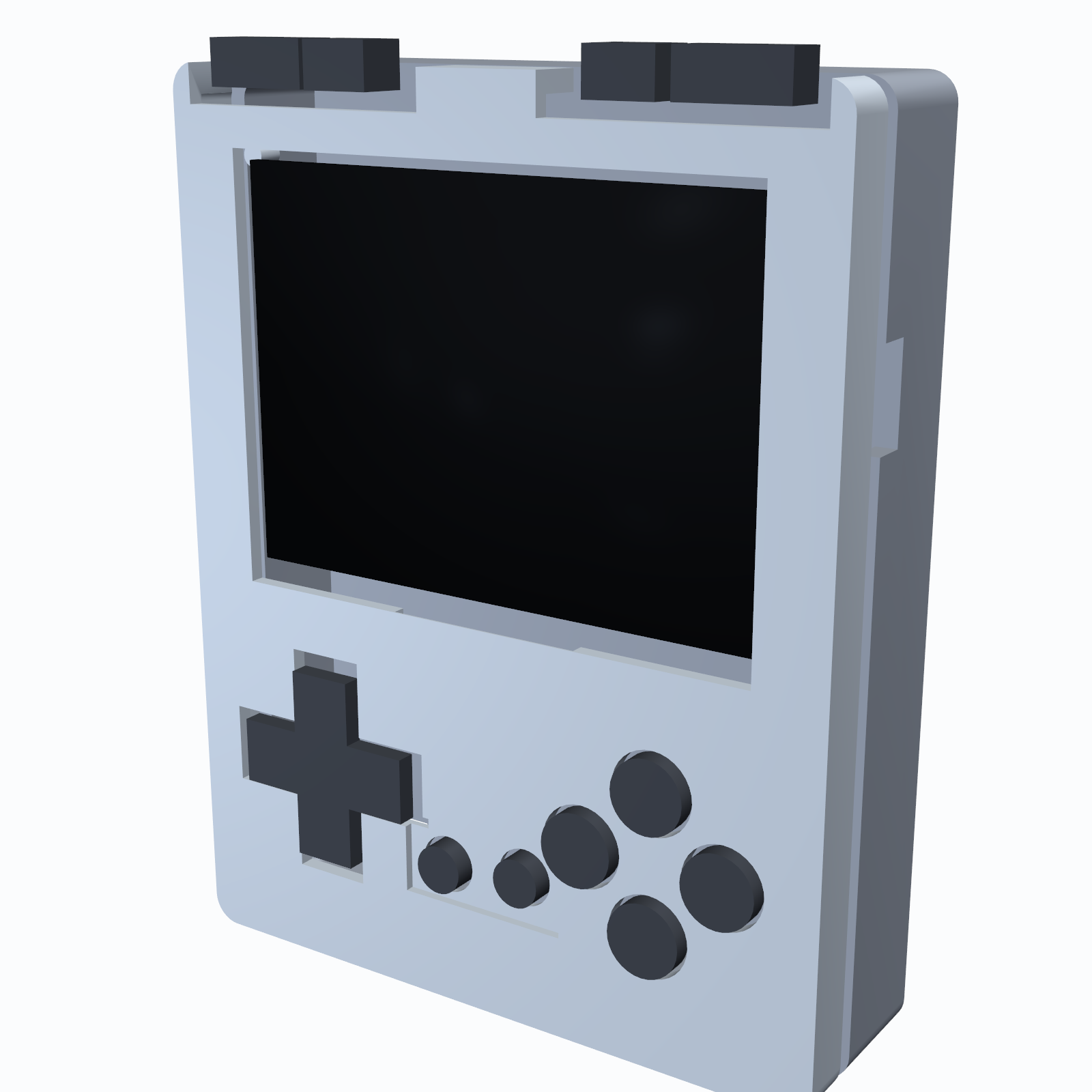 | 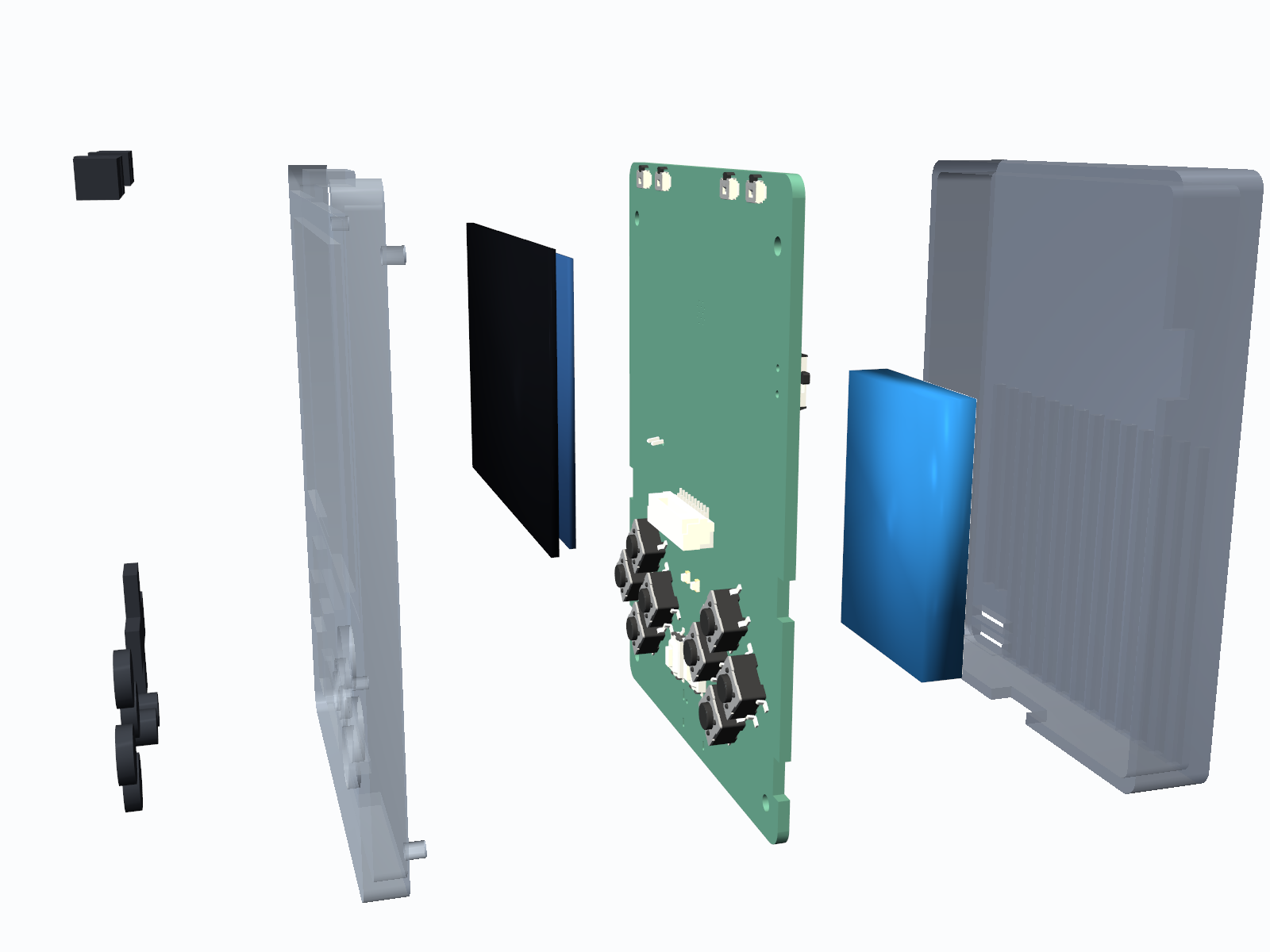 |
| Assembled enclosure | Front Bezel, PCBA, Floating Keycaps, Rear Shell & Door |
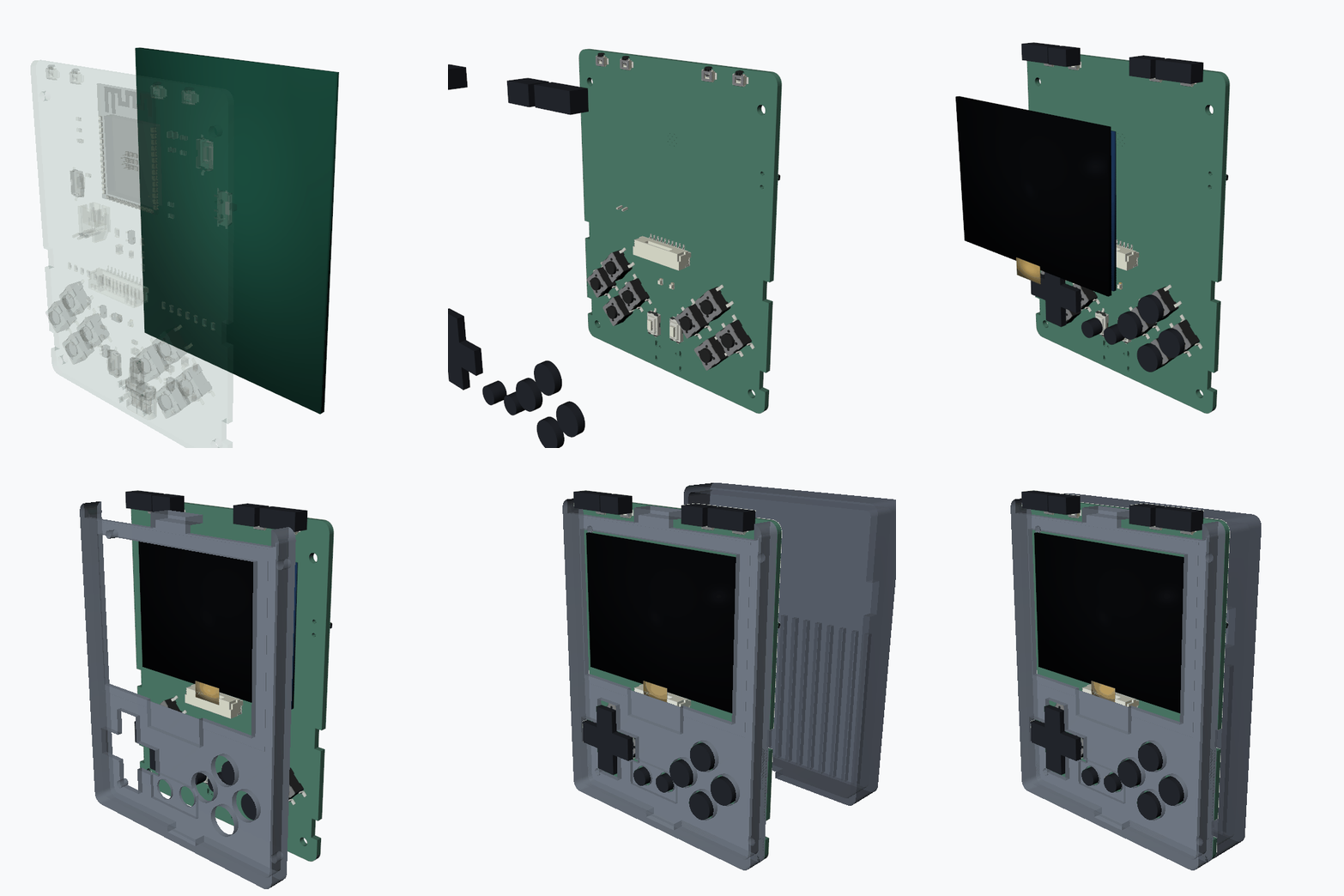
Sequential 3D Assembly Animation: PCBA SMT/TH Component Populating → Gamepad Keycaps Seating over Tactile Switches → 2.4" Display Panel Seating & FPC Interconnect into J3 → Front Bezel Lowering over Controls & Alignment Pins → Li-Po Battery Seating into Rear Cavity → Rear Grooved Shell Closing & Flush Snap Mating → 360° Watertight Turntable Inspection
High-definition MP4 video asset: docs/images/case_assembly_video.mp4
Front Layer (F.Cu — Tactile Controls & Display) | Back Layer (B.Cu — ESP32-S3, USB-C & Power ICs) |
|---|---|
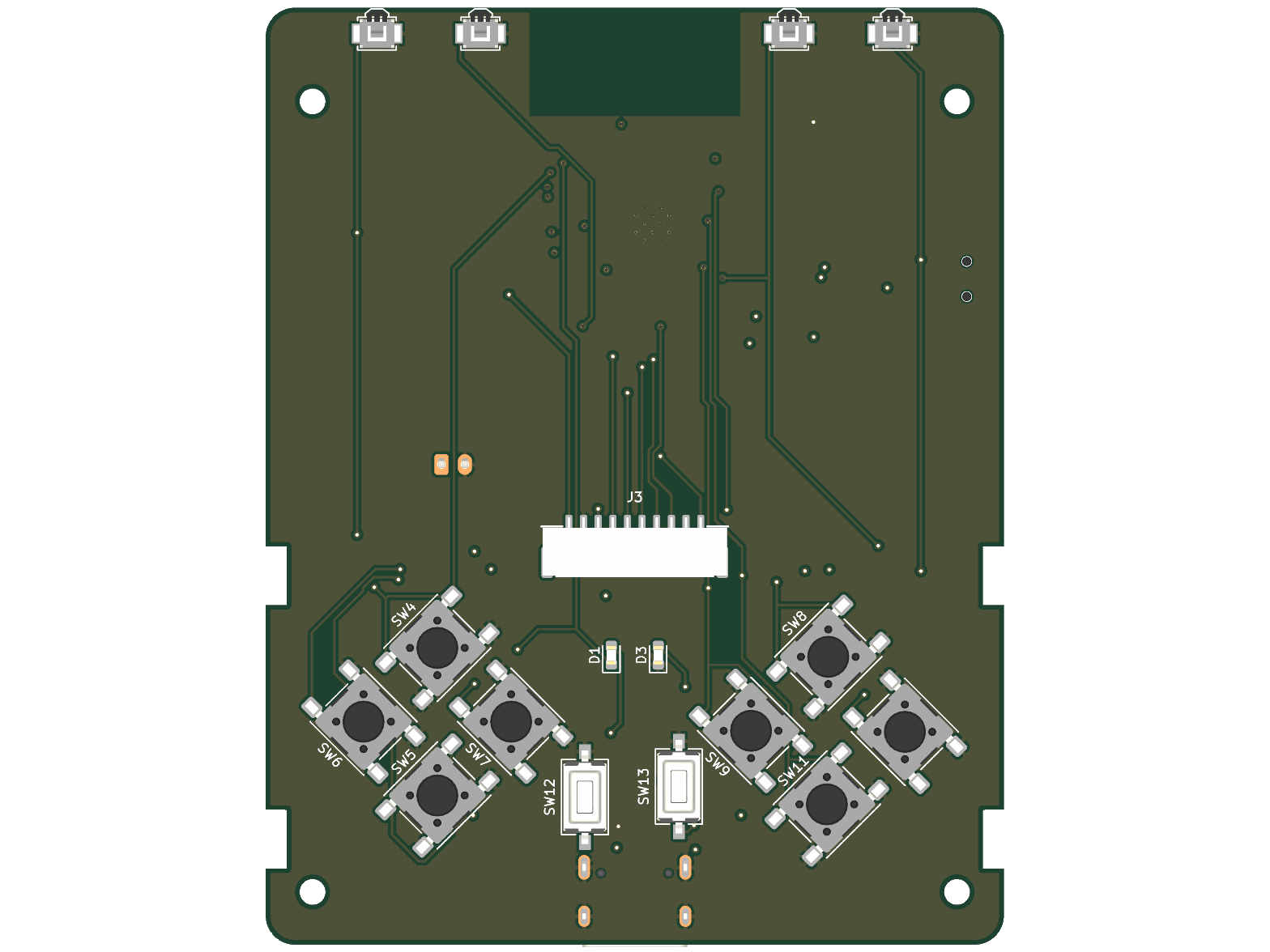 | 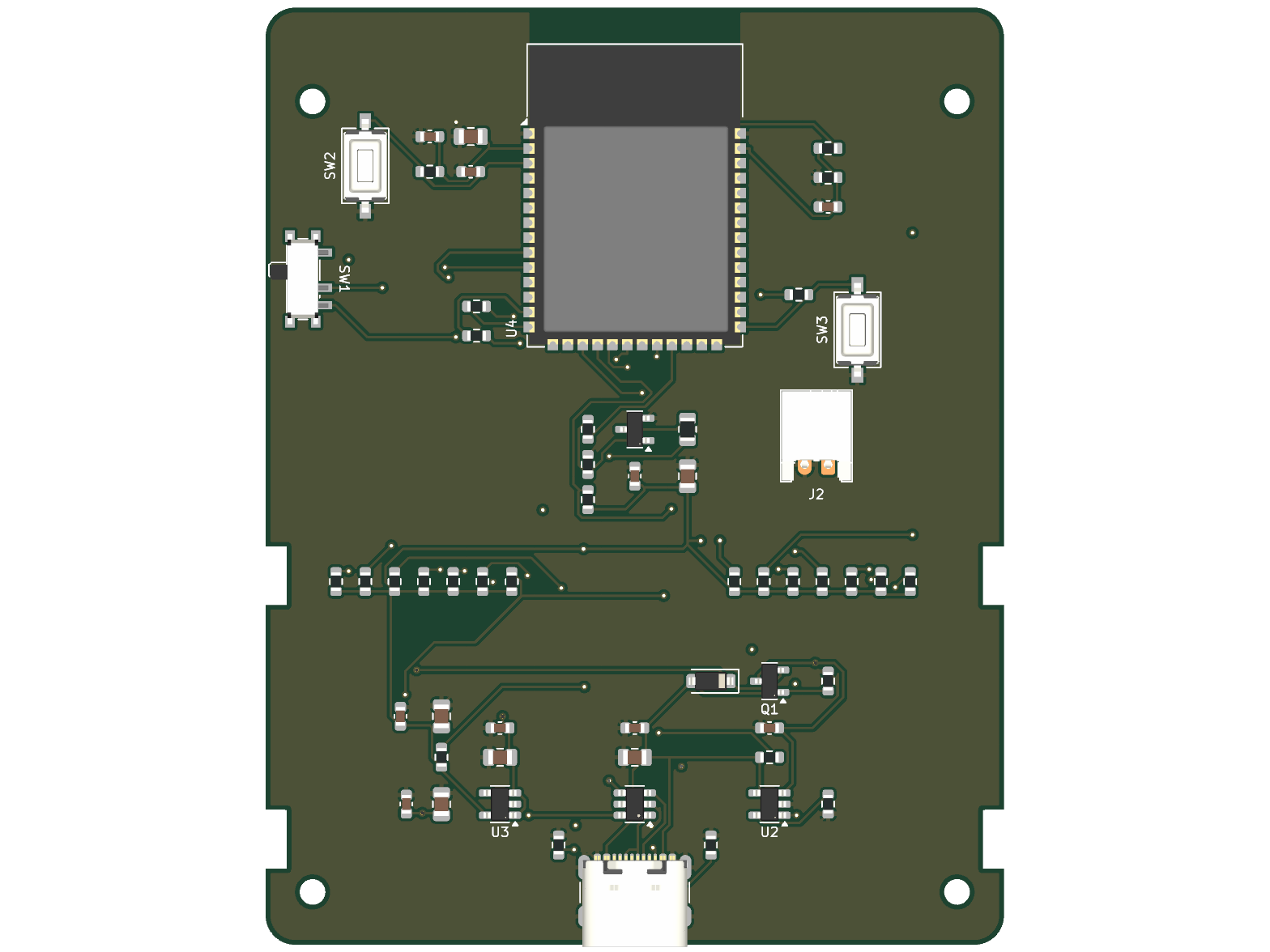 |
kicad-cli pcb render)| KiCad 3D Top View (Tactile Controls, JST-GH J3 & Top Shoulder Switches) | KiCad 3D Bottom View (ESP32-S3 Module, USB-C, JST-PH & Power Management) |
|---|---|
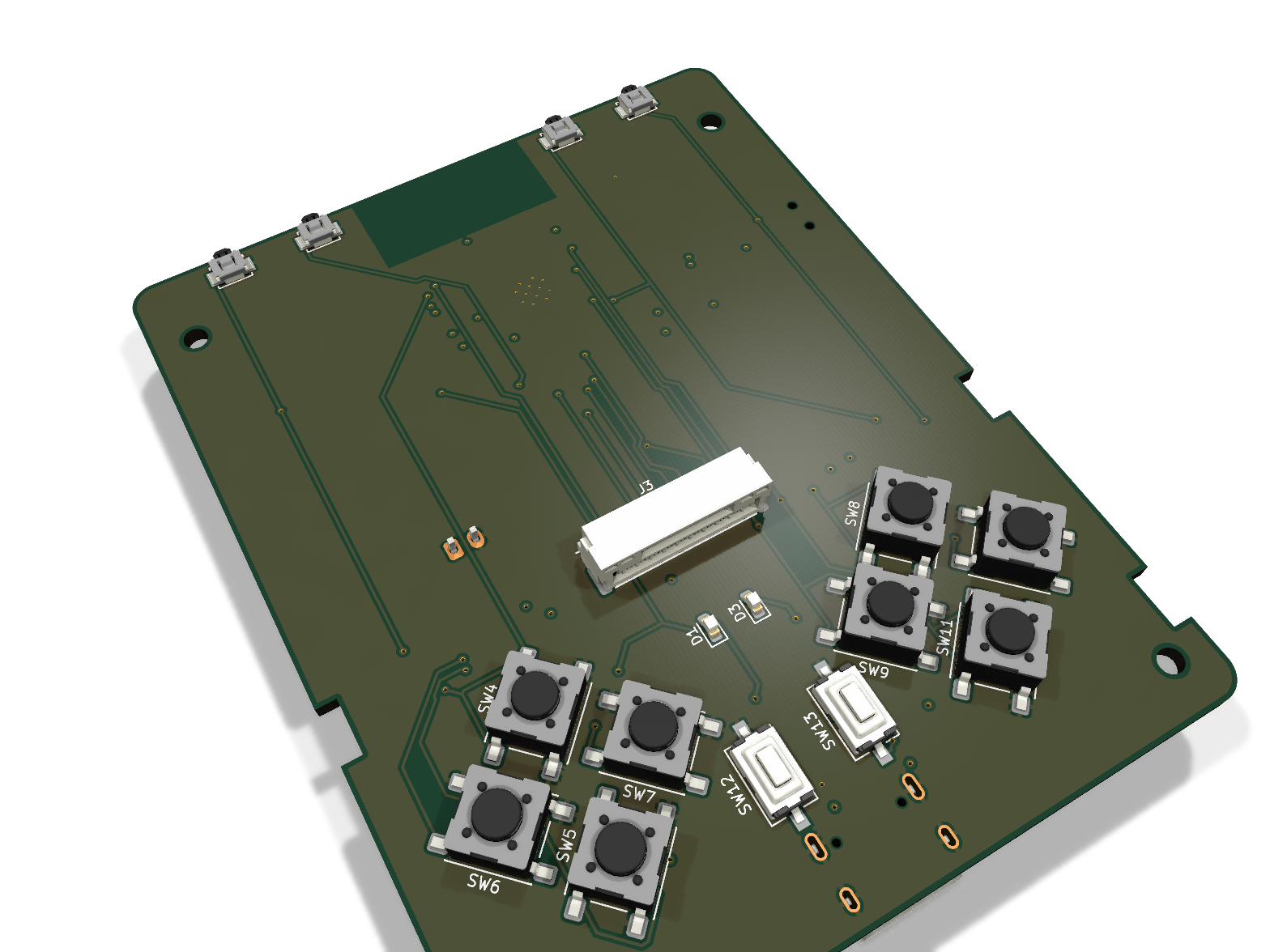 | 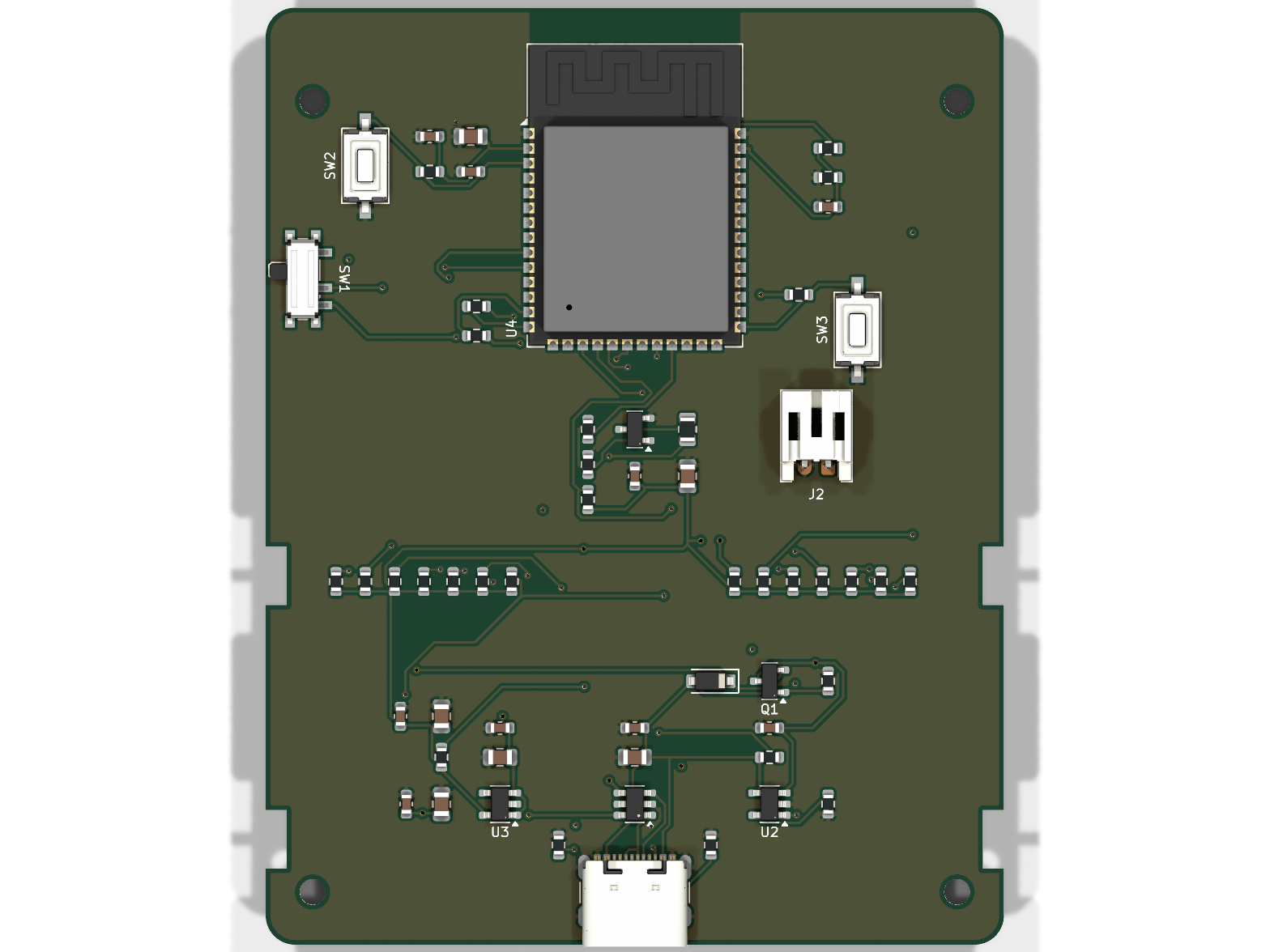 |
| Populated Front: 14x Tactile Switches, J3 Display Receptacle, D1/D3 LEDs | Populated Back: ESP32-S3-WROOM-1, USB-C, JST-PH Battery Header, LDO & Charger |
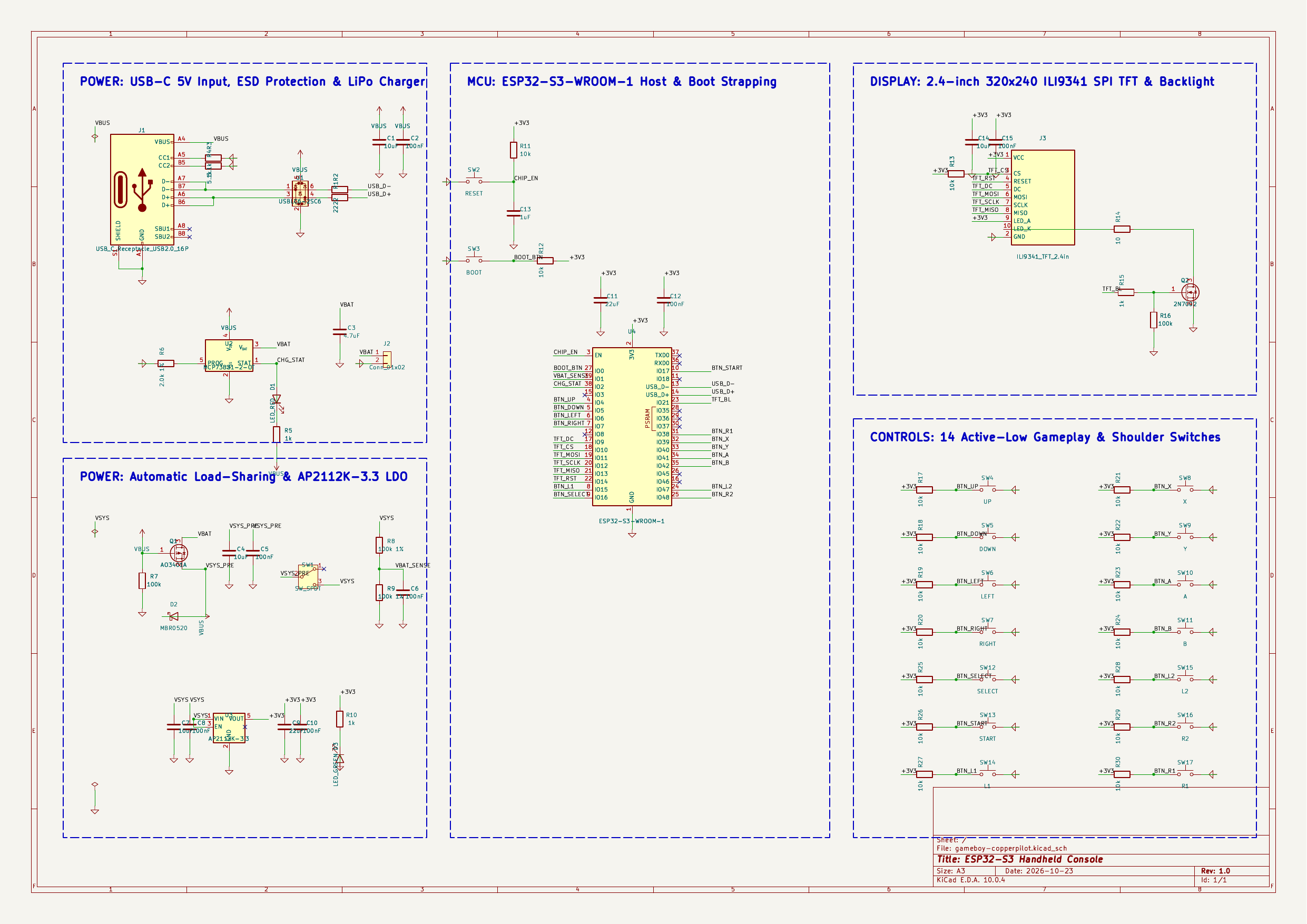
Complete 6-Block Schematic Capture (USB-C Power, Li-Po Charger, Load Sharing, ESP32-S3 Core, ILI9341 TFT & 14 Pushbuttons)
                    +-------------------------------------------------------+
                    |                   Power Subsystem                     |
                    | USB-C (J1) ---> USBLC6-2SC6 (U1) ESD Protection       |
                    |                 |                                     |
                    |                 +---> MCP73831 (U2) Charger (500mA)   |
                    |                 |     |                               |
                    |                 |     v                               |
                    |                 |    JST-PH 1S LiPo (J2)              |
                    |                 |     |                               |
                    |                 v     v                               |
                    |           AO3401A (Q1) + MBR0520 (D2) Power Path      |
                    |                       | (Auto Load-Sharing)           |
                    |                       v                               |
                    |              Main Power Switch (SW1)                  |
                    |                       |                               |
                    |                       +---> 100k/100k Divider (IO1)   |
                    |                       v                               |
                    |              AP2112K-3.3 (U3) 600mA LDO               |
                    +-----------------------|-------------------------------+
                                            | +3.3V System Rail
+--------------------------+  Hardware FSPI +-------------------------------+
|  2.4" 320x240 ILI9341    |<---------------|       ESP32-S3-WROOM-1        |
|  SPI Color TFT (J3)      |  SCK, MOSI,    |  Dual-Core Xtensa LX7 240MHz  |
| 2N7002 Backlight Driver |<---------------| 512KB SRAM, 8MB Flash |H1–H4), and 4 through-PCB snap-hook retention notches (SL1, SL2, SR1, SR2).J3:
J3): JST Sales America SM10B-GHS-TB(LF)(SN) (10-position 1.25 mm pitch horizontal SMD header with solder retention tabs).DISP1): Waveshare 15933 (MPN: 15933 / DigiKey: 2649-15933-ND / LCSC: C2913222) or EastRising ER-TFT024-3.
GHR-10V-S.Q2) with 10 Ω ballast resistor (R14) and 100 kHz PWM brightness dimming on GPIO21.R_PROG = 2.0 kΩ 1%).Q1, $R_{DS(on)} < 50\text{ m}\Omega$) and MBR0520 Schottky barrier diode (D2, $V_F = 0.38\text{ V}$). When 5V USB-C is plugged in, the system runs directly off USB power while the battery charges undisturbed at its full C-rate; upon disconnect, the MOSFET transparently switches system load back to battery without voltage droop.R8, R9) with 100 nF smoothing capacitor (C6) on ESP32-S3 ADC1_CH0 (GPIO1) for fuel gauge battery telemetry.UP, DOWN, LEFT, RIGHT) centered at (14.65, 60.96 mm).A, B, X, Y) centered at (47.97, 61.75 mm).SELECT, START) centered at (31.24, 69.70 mm).L1, L2, R1, R2) centered at (9.50, 18.33, 53.50, 44.67 mm).The hardware has been validated against Lion Circuits India turnkey PCBA design and procurement standards:
| Fabrication Parameter | Lion Circuits Standard Capability | Handheld Console Implementation | Design Margin |
|---|---|---|---|
| Layer Count | 4-Layer Multi-Layer FR-4 | 4 Layers (F.Cu, In1.Cu, In2.Cu, B.Cu) | Standard |
| Finished Thickness | 1.6 mm nominal (+/- 10%) | 1.60 mm | Exact Nominal |
| Copper Weight | 1.0 oz outer / 0.5 oz inner | 1.0 oz (35 µm) outer / 0.5 oz (17.5 µm) inner | Standard |
| Minimum Trace Width | 6 mil (0.1524 mm) | 6 mil (0.1524 mm) min / 8 mil (0.20 mm) typ | 100% Fab Compliant |
| Minimum Trace Spacing | 6 mil (0.1524 mm) | 6 mil (0.1524 mm) min / 8 mil (0.20 mm) typ | 100% Fab Compliant |
| Via Drill & Diameter | 0.30 mm drill / 0.60 mm pad | 0.30 mm drill / 0.60 mm diameter | Exact Standard Spec |
| Annular Ring | 6 mil (0.152 mm) minimum | 0.150 mm (6 mil) | 100% Fab Compliant |
| Copper to Board Edge | 12 mil (0.30 mm) minimum | 0.40 mm (16 mil) | +33% Safety Margin |
| Surface Finish | Lead-Free HASL or ENIG | Electroless Nickel Immersion Gold (ENIG) | Superior SMT Coplanarity |
| Solder Mask & Silk | Matte Black Mask / White Silk | Matte Black / High-Contrast White | Premium Aesthetic |
| Item | Designators | Qty | Part / Value | Manufacturer | MPN | Package | Sourcing Channel |
|---|---|---|---|---|---|---|---|
| 1 | U4 | 1 | Dual-Core MCU + PSRAM | Espressif Systems | ESP32-S3-WROOM-1-N8R2 | SMD-41 (18x25.5mm) | DigiKey / Mouser / LCSC |
| 2 | J1 | 1 | USB-C 2.0 16-Pin Receptacle | GCT / Hroparts | USB4105-GF-A / TYPE-C-31-M-12 | USB-C-16P-TopMount | DigiKey / LCSC |
| 3 | U1 | 1 | Rail-to-Rail ESD Diode Array | STMicroelectronics | USBLC6-2SC6 | SOT-23-6 | DigiKey / Mouser |
| 4 | U2 | 1 | 500mA Li-Po Charger | Microchip Technology | MCP73831T-2ACI/OT | SOT-23-5 | DigiKey / Mouser |
| 5 | Q1 | 1 | P-MOSFET Load Sharing | Alpha & Omega Semi | AO3401A | SOT-23 | DigiKey / LCSC |
| 6 | D2 | 1 | 20V 0.5A Schottky Diode | ON Semiconductor | MBR0520LT1G | SOD-123 | DigiKey / Mouser |
| 7 | U3 | 1 | 600mA Ultra-Low-Dropout LDO | Diodes Incorporated | AP2112K-3.3TRG1 | SOT-23-5 | DigiKey / Mouser |
| 8 | Q2 | 1 | 60V 300mA N-MOSFET Backlight | Nexperia | 2N7002,215 | SOT-23 | DigiKey / Mouser |
| 9 | D1 | 1 | Red LED (Charge Indicator) | Lite-On Inc. | LTST-C190KRKT | 0603 SMD | DigiKey / Mouser |
| 10 | D3 | 1 | Green LED (Power Good) | Lite-On Inc. | LTST-C190KGKT | 0603 SMD | DigiKey / Mouser |
| 11 | J2 | 1 | JST-PH 2-Pin Battery Header | JST Sales America | S2B-PH-K-S(LF)(SN) | JST_PH_1x02_P2.00mm | DigiKey / Mouser |
| 12 | J3 | 1 | JST-GH 10-Pin Display Socket | JST Sales America | SM10B-GHS-TB(LF)(SN) | 10-Pin 1.25mm SMT | DigiKey / Mouser |
| 13 | SW1 | 1 | SPDT Power Slide Switch | C&K / Hroparts | PCM12SMTR / MSK-12C02 | SMT Slide Switch | DigiKey / LCSC |
| 14 | SW4-SW11 | 8 | 6x6mm Tactile Switches | C&K Components | PTS645SM43SMTR92 LFS | 6.0x6.0mm SMD | DigiKey / Mouser |
| 15 | SW12,SW13,SW2,SW3 | 4 | 6x3.5mm Tactile Switches | C&K Components | PTS636 SM25 LFS | 6.0x3.5mm SMD | DigiKey / Mouser |
| 16 | SW14-SW17 | 4 | Ultra-Small Tactile Switches | Omron Electronics | B3U-3000P | 3.0x2.5mm SMD | DigiKey / Mouser |
| 17 | DISP1 | 1 | 2.4" 320x240 ILI9341 SPI TFT | Waveshare / EastRising | 15933 / ER-TFT024-3 | 2.4" Module + Cable | DigiKey / LCSC / Waveshare |
| 18 | BT1 | 1 | 3.7V 1000mAh 1S Li-Po Cell | PKCELL / Adafruit | LP803040 / ID 258 | 40x30x8.0mm JST-PH | DigiKey / Adafruit |
| 19 | CASE1 | 1 | CopperPilot Retro Handheld 3D Snap-Fit Case Kit | CopperPilot (in-house design) | CP-RETRO-HANDHELD-CASE-V1 | 3D Watertight Enclosure | 3D Printed / Molded |
| 20-34 | C1-C15 | 15 | Ceramic MLCC Decoupling | Yageo / Murata | 100nF, 1uF, 4.7uF, 10uF, 22uF | 0603 & 0805 | DigiKey / LCSC |
| 35-45 | R1-R30 | 30 | Precision Chip Resistors | Yageo / Vishay | 10, 22, 1k, 2k 1%, 5.1k, 10k, 100k 1% | 0603 & 0805 | DigiKey / LCSC |
The repository includes a 51-point automated PyTest hardware, assembly, and enclosure verification suite:
$ make test
============================= test session starts ==============================
platform linux -- Python 3.13.9, pytest-9.1.1
collected 51 items

tests/test_assembly_e2e.py::TestEndToEndAssemblySequence::test_stage1_pcba_component_loading PASSED
tests/test_assembly_e2e.py::TestEndToEndAssemblySequence::test_stage2_kicad_3d_pcba_mesh_validation PASSED
tests/test_assembly_e2e.py::TestEndToEndAssemblySequence::test_stage3_buttons_clearance_and_zero_collision PASSED
tests/test_assembly_e2e.py::TestEndToEndAssemblySequence::test_stage4_buttons_seat_onto_pcba_zero_collision PASSED
tests/test_assembly_e2e.py::TestEndToEndAssemblySequence::test_stage5_buttons_seat_in_front_bezel_zero_collision PASSED
tests/test_assembly_e2e.py::TestEndToEndAssemblySequence::test_stage6_display_shelf_mating_and_j3_interconnect PASSED
tests/test_assembly_e2e.py::TestEndToEndAssemblySequence::test_stage7_pcba_mating_to_front_bezel_zero_collision PASSED
tests/test_assembly_e2e.py::TestEndToEndAssemblySequence::test_stage8_rear_shell_mating_over_pcb_zero_collision PASSED
tests/test_assembly_e2e.py::TestEndToEndAssemblySequence::test_stage9_battery_seating_and_rear_cavity_fit PASSED
tests/test_assembly_e2e.py::TestEndToEndAssemblySequence::test_stage10_continuous_kinematic_assembly_trajectories PASSED
tests/test_assembly_e2e.py::TestEndToEndAssemblySequence::test_stage11_full_console_assembly_envelope PASSED
tests/test_case.py::TestCaseFiles::test_stl_file_exists[case_front_bezel.stl] PASSED
tests/test_case.py::TestCaseFiles::test_stl_file_exists[case_rear_grooved.stl] PASSED
tests/test_case.py::TestCaseFiles::test_stl_file_exists[case_battery_door.stl] PASSED
tests/test_case.py::TestCaseFiles::test_stl_file_exists[buttons_dpad_abxy_sest_shoulders.stl] PASSED
tests/test_case.py::TestCaseFiles::test_stl_file_exists[copperpilot_retro_handheld_assembly.stl] PASSED
tests/test_case.py::TestCaseGeometry::test_front_bezel_envelope PASSED
tests/test_case.py::TestCaseGeometry::test_rear_shell_envelope PASSED
tests/test_case.py::TestCaseGeometry::test_battery_door_envelope PASSED.
├── Makefile # Top-level orchestrator (test, drc, erc, fab, gerbers)
├── .gitignore # Comprehensive Git exclusion rules
├── LICENSE # CERN Open Hardware Licence v2 - Permissive
├── README.md # Master hardware, pinout, and manufacturing documentation
├── export_manufacturing.py # Lion Circuits release generator (Gerbers, CPL, BOM, D356)
├── copperpilot-retro-handheld.kicad_pro # KiCad 10 project definition & netclass rules
├── copperpilot-retro-handheld.kicad_sch # Hierarchical schematic capture (0 ERC errors)
├── copperpilot-retro-handheld.kicad_pcb # 4-layer PCB layout (100% routed, 0 DRC violations)
├── sym-lib-table # Symbol library mapping
├── fp-lib-table # Footprint library mapping
├── libs/ # Custom symbols and footprints
│ ├── copperpilot_retro_handheld.kicad_sym # Custom ILI9341 2.4" TFT display symbol
│ └── copperpilot_retro_handheld.pretty/ # Custom 10-pin display footprint & 3D model
├── tests/ # Automated 51-point hardware & assembly verification suite
│ ├── conftest.py # S-expression AST parsers & KiCad CLI fixtures
│ ├── test_assembly_e2e.py # 11-stage end-to-end mechanical assembly verification
│ ├── test_pcb.py # 25-point PCB geometry, connectivity, DFM & circuit tests
│ └── test_case.py # 15-point 3D mechanical enclosure & clearance tests
├── case/ # Parametric 3D snap-fit enclosure CAD subsystem
│ ├── Makefile # Targets: generate, render, test, clean
│ ├── README.md # Enclosure mechanics, snap-fit physics & 3D print specs
│ ├── generate_case.py # Parametric CSG mesh synthesis in Trimesh & Manifold3D
│ ├── render_case.py # High-resolution PyVista rendering & animation engineEnsure kicad-cli (v10.0+) and Python 3.10+ (with uv) are available in your path:
# Run full 51-point PyTest verification suite (installs test deps via uv)
make test

# Run electrical rule check (ERC) via KiCad CLI
kicad-cli sch erc copperpilot-retro-handheld.kicad_sch

# Run design rule check (DRC) via KiCad CLI
kicad-cli pcb drc copperpilot-retro-handheld.kicad_pcb# Generate watertight STL models
make build-case
# Render smooth anti-aliased images and assembly animation
make render-case# Generate gerbers, drill, CPL, structured BOM, and release zip
make fab| Qty | Value | Footprint | References |
|---|---|---|---|
| 17 | 10k | R_0603_1608Metric | R11, R12, R13, R17, R18, R19, R20, R21, R22, R23, R24, R25, R26, R27, R28, R29 +1 |
| 7 | 100nF | C_0603_1608Metric | C2, C5, C6, C8, C10, C12, C15 |
| 4 | 10uF | C_0805_2012Metric | C1, C4, C7, C14 |
| 3 | 1k | R_0603_1608Metric | R5, R10, R15 |
| 2 | 100k | R_0603_1608Metric | R7, R16 |
| 2 | 100k 1% | R_0603_1608Metric | R8, R9 |
| 2 | 22 | R_0603_1608Metric | R1, R2 |
| 2 | 22uF | C_0805_2012Metric | C9, C11 |
| 2 | 5.1k | R_0603_1608Metric | R3, R4 |
| 1 | 10 | R_0805_2012Metric | R14 |
| 1 | 1uF | C_0603_1608Metric | C13 |
| 1 | 2.0k 1% | R_0603_1608Metric | R6 |
| 1 | 2N7002 | SOT-23 | Q2 |
| 1 | 4.7uF | C_0603_1608Metric | C3 |
| 1 | A | SW_SPST_PTS645Sx43SMTR92 | SW10 |
| 1 | AO3401A | SOT-23 | Q1 |
| 1 | AP2112K-3.3 | SOT-23-5 | U3 |
| 1 | B | SW_SPST_PTS645Sx43SMTR92 | SW11 |
| 1 | BOOT | SW_Tactile_SPST_NO_Straight_CK_PTS636Sx25SMTRLFS | SW3 |
| 1 | Conn_01x02 | JST_PH_S2B-PH-K_1x02_P2.00mm_Horizontal | J2 |
| 1 | DOWN | SW_SPST_PTS645Sx43SMTR92 | SW5 |
| 1 | ESP32-S3-WROOM-1 | ESP32-S3-WROOM-1 | U4 |
| 1 | ILI9341_TFT_2.4in | ILI9341_TFT_2.4in_10P | J3 |
| 1 | L1 | SW_SPST_B3U-3000P | SW14 |
| 1 | L2 | SW_SPST_B3U-3000P | SW15 |
| 1 | LED_GREEN | LED_0603_1608Metric | D3 |
| 1 | LED_RED | LED_0603_1608Metric | D1 |
| 1 | LEFT | SW_SPST_PTS645Sx43SMTR92 | SW6 |
| 1 | MBR0520 | D_SOD-123 | D2 |
| 1 | MCP73831-2-OT | SOT-23-5 | U2 |
| 1 | R1 | SW_SPST_B3U-3000P | SW17 |
| 1 | R2 | SW_SPST_B3U-3000P | SW16 |
| 1 | RESET | SW_Tactile_SPST_NO_Straight_CK_PTS636Sx25SMTRLFS | SW2 |
| 1 | RIGHT | SW_SPST_PTS645Sx43SMTR92 | SW7 |
| 1 | SELECT | SW_Tactile_SPST_NO_Straight_CK_PTS636Sx25SMTRLFS | SW12 |
| 1 | START | SW_Tactile_SPST_NO_Straight_CK_PTS636Sx25SMTRLFS | SW13 |
| 1 | SW_SPDT | SW_SPDT_PCM12 | SW1 |
| 1 | UP | SW_SPST_PTS645Sx43SMTR92 | SW4 |
| 1 | USBLC6-2SC6 | SOT-23-6 | U1 |
| 1 | USB_C_Receptacle_USB2.0_16P | USB_C_Receptacle_GCT_USB4105-xx-A_16P_TopMnt_Horizontal | J1 |
| 1 | X | SW_SPST_PTS645Sx43SMTR92 | SW8 |
| 1 | Y | SW_SPST_PTS645Sx43SMTR92 | SW9 |


MuffinByteLabs/esp32s3-plant-monitor
Portfolio PCB: ESP32-S3 Wi-Fi plant monitor. 4-layer KiCad 10 design, fabricated and assembled at JLCPCB — schematic, reviews and the frozen manufacturing package all readable in-browser.


lalithk06/PCB_Designs
This repository contains various PCB design projects made using KiCad

Vishalbabu-09/Auralab_Workstation
Advanced 4-layer PCB design featuring split-plane noise isolation (AGND/DGND) and asynchronous dual-core processing. Implements a handheld multi-tool oscilloscope, current tracker, and symmetrical DC power supply.
It measures 63 × 80 mm and has 4 copper layers, 1.6 mm thick.
74 parts, built around the ESP32-S3-WROOM-1-N8, AP2112K-3.3, USBLC6-2SC6 and AO3401A. The full list of its parts is on this page, with links to each part's symbol and footprint where PCBKit's library has them.
From the CopperPilot/retro-handheld-copperpilot repository on GitHub, at the commit this page was made from: the board is copperpilot-retro-handheld.kicad_pcb and its schematic copperpilot-retro-handheld.kicad_sch. PCBKit opens the board in the browser, with nothing to install.
Its repository states no licence, so its author keeps all rights: ask CopperPilot before reusing the design.