2 layers13.7 × 14.7 mm
Button
ByteSyze/CompanionCube
A small project demonstrating 3D modelling, circuit design, and basic MCU firmware.
5 parts
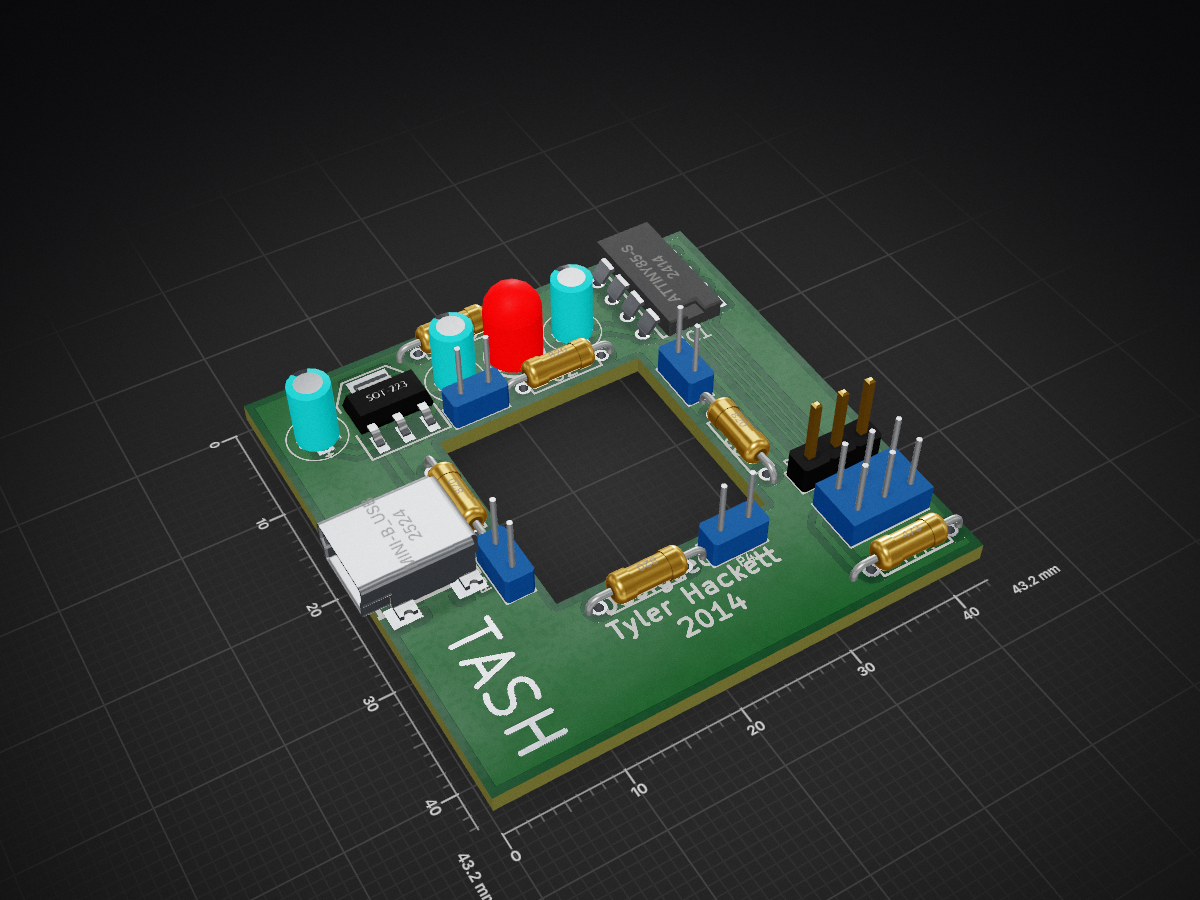
 ByteSyze/CompanionCube
A small project demonstrating 3D modelling, circuit design, and basic MCU firmware.
Companion Cube is an open-source printed circuit board by ByteSyze, from the ByteSyze/CompanionCube repository on GitHub. It is a 2-layer board of 43.2 × 43.2 mm with 21 parts on 14 nets, routed with 68 tracks and 1 via.
Its parts include 8 connectors, 6 resistors, 3 capacitors, 2 ICs and 1 diode. It belongs with the AVR (ATmega, ATtiny) boards of this library.
This 3D LED Companion Cube project will contain all necessary information to create a 3D printed companion cube with an internal circuit to make the hearts flash.
The original companion cube model was created by Poh and downloaded from thingiverse here: http://www.thingiverse.com/thing:33138
The circuit is based on an attiny13 MCU, that will require additional hardware to program (e.g. AVR mkII or ATMEL-ICE). All schematics and circuits are designed in KiCAD.
| Qty | Value | Footprint | References |
|---|---|---|---|
| 4 | 82 | R3 | R1, R2, R3, R4 |
| 3 | CONN_1 | PIN_ARRAY_1 | P5, P6, P7 |
| 2 | 10uF | C1V5 | C1, C2 |
| 1 | 130 | R3 | R5 |
| 1 | 1uF | C1V5 | C3 |
| 1 | 47K | R3 | R6 |
| 1 | ATTINY85-S | DIP-8__300 | IC1 |
| 1 | AVR-ISP-6 | pin_array_3x2 | CON1 |
| 1 | LED_1 | PIN_ARRAY_2X1 | P4 |
| 1 | LED_2 | PIN_ARRAY_2X1 | P3 |
| 1 | LED_3 | PIN_ARRAY_2X1 | P2 |
| 1 | LED_4 | PIN_ARRAY_2X1 | P1 |
| 1 | MINI-B_USB | USB_MINI_B | U1 |
| 1 | RED | LEDV | D1 |
| 1 | TC1262 | SOT223 | RG1 |
ByteSyze/CompanionCube
A small project demonstrating 3D modelling, circuit design, and basic MCU firmware.

gusmanb/logicanalyzer
24 channel, 100Msps logic analyzer hardware and software

mntmn/amiga2000-gfxcard
MNT VA2000, an Open Source Amiga 2/3/4000 Graphics Card (Zorro II/III), written in Verilog


hackclub/OnBoard
💡 Join 1,000 teenagers and make your first PCB with a $100 grant!

drandyhaas/KiCadRoutingTools
A set of Python/Rust tools to aid routing in KiCad

Arrow-air/project-quiver
Project Quiver documentation, designs, and project artifacts.


It measures 43.2 × 43.2 mm and has 2 copper layers, 1.6 mm thick.
21 parts. The full list of its parts is on this page, with links to each part's symbol and footprint where PCBKit's library has them.
From the ByteSyze/CompanionCube repository on GitHub, at the commit this page was made from: the board is src/Circuit/Companion_Cube_DIP/Companion_Cube.kicad_pcb. PCBKit opens the board in the browser, with nothing to install.
Its repository states no licence, so its author keeps all rights: ask ByteSyze before reusing the design.