

4 layers93.7 × 43.7 mm
Flight Computer
SunDevilRocketry/Flight-Computer
General purpose flight computer for high powered rocketry projects.
113 parts5
A Biomorphic Whisker Sensor for Aerial Tactile Applications , Chaoxiang Ye, Guido de Croon, and Salua Hamaza. 2024 IEEE International Conference on Robotics and Automation (ICRA 2024).
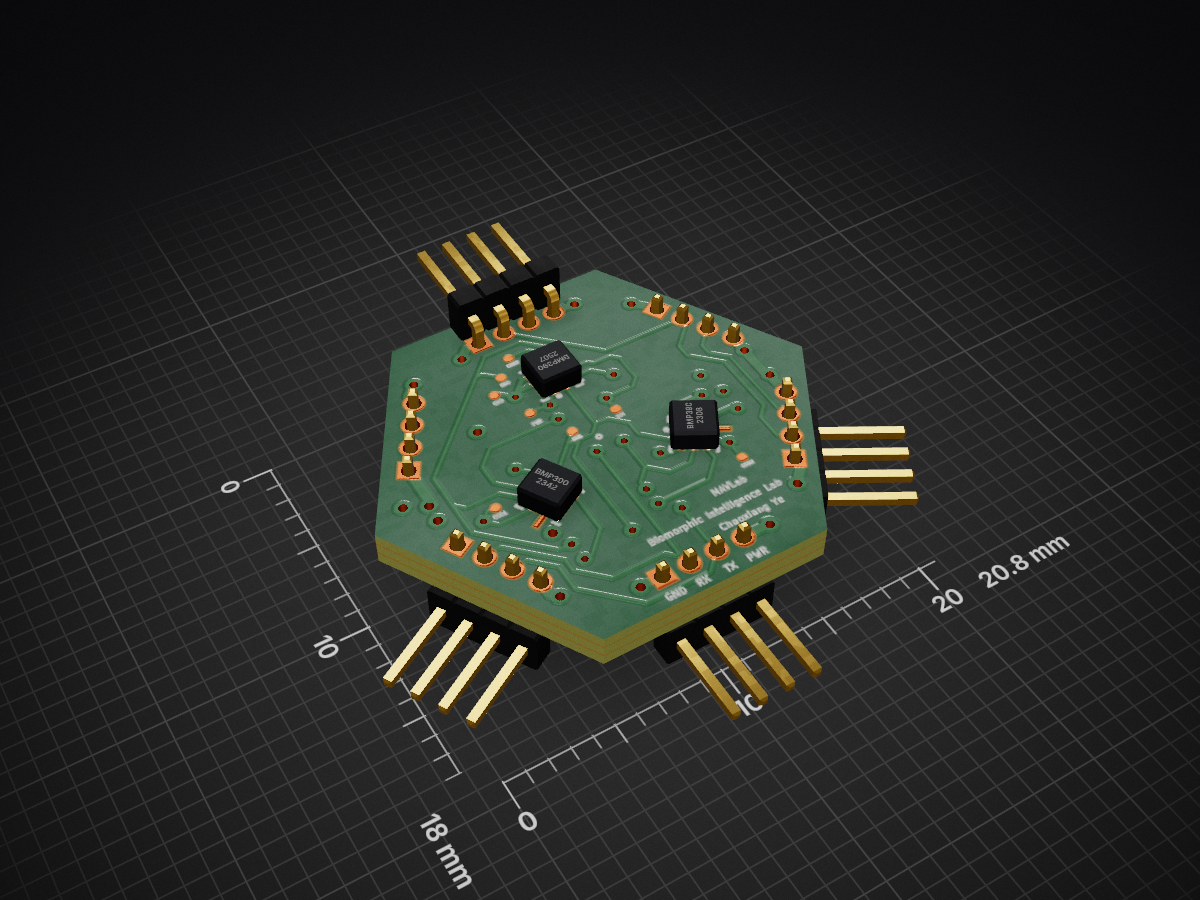
Whisker is an open-source printed circuit board by BioMorphic-Intelligence-Lab, from the BioMorphic-Intelligence-Lab/Whisker-3D-Localization repository on GitHub. It is a 4-layer board of 20.8 × 18 mm with 29 parts on 22 nets, routed with 306 tracks and 37 vias.
It is built around the BMP390. Its parts include 10 capacitors, 6 connectors, 4 ICs and 1 resistor. It belongs with the STM32 boards of this library.
This repository contains open-source files for paper:
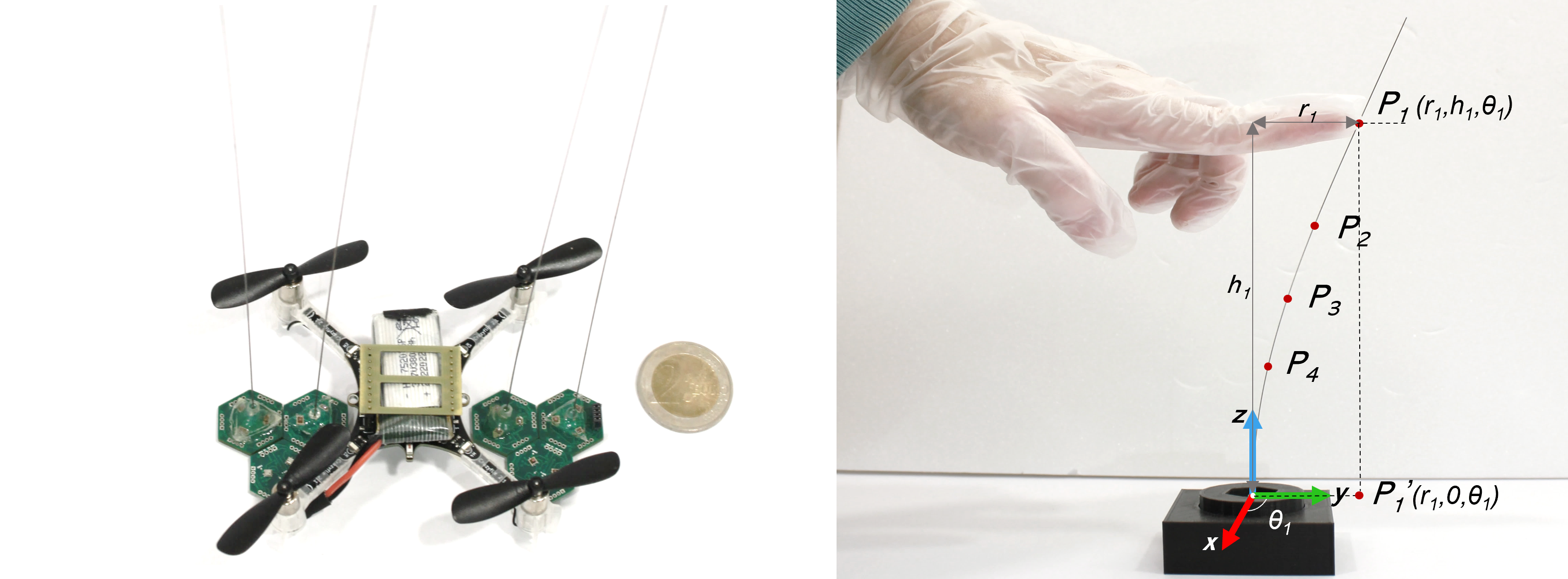
A Biomorphic Whisker Sensor for Aerial Tactile Applications, Chaoxiang Ye, Guido de Croon, and Salua Hamaza.
2024 IEEE International Conference on Robotics and Automation (ICRA 2024).
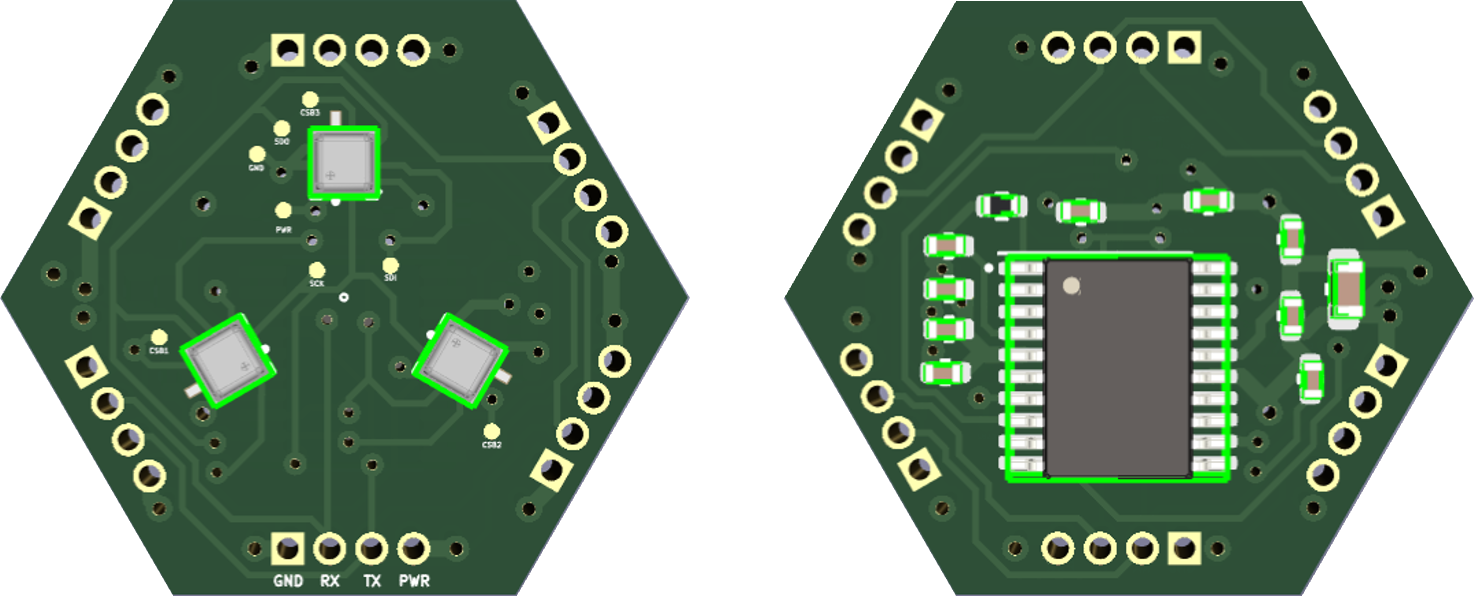
Including KiCAD files and the manufacturer's files. The manufacturer's files encompass the gerber file, Bill of Materials (BOM), and position file. The primary electronic components consist of barometers and microcontrollers. To optimize sensing ability and PCB size, we recommend utilizing the BMP390 along with the STM32F070F6. In the event of a microcontroller substitution, we recommend choosing for one with a minimum of 32Kbytes flash memory.

Including all programs utilizing the STM32 to read data from three BMP390s. The SPI bus is employed for communication between the STM32 and the BMP390, where the chip select pins are sequentially lowered to read sensor data in sequence. Additionally, a UART is utilized for communication between the STM32 and the PC.
We use the In-system programming (ISP) to download the program into the STM32. Initially, the BOOT0 pin necessitates a pull-up, which entails soldering an additional wire on the PCB, connecting BOOT0 to any of the leads linked to the 3.3V (PWR-layer). Subsequently, employ the MCU ISP software to flash the "whiskeropt2.0.hex" file from the Data Reading folder onto the STM32, ensuring the baud rate is set to 115200. Please be aware that when reading data, it is imperative to configure the baud rate in accordance with the parameter specified in the "usart.c" file. In this instance, we have set it to 230400.
We suggest to create a conda env
conda create -n whisker python=3.8Clone the source code from our github repository
git clone https://github.com/BioMorphic-Intelligence-Lab/Whisker-3D-Localization.git
cd Whisker-3D-Localization
We implemented this code, under the following packages:
using conda to install the above packages.
Scikit-learn is exclusively utilized for selecting hyperparameters in the grid search process.
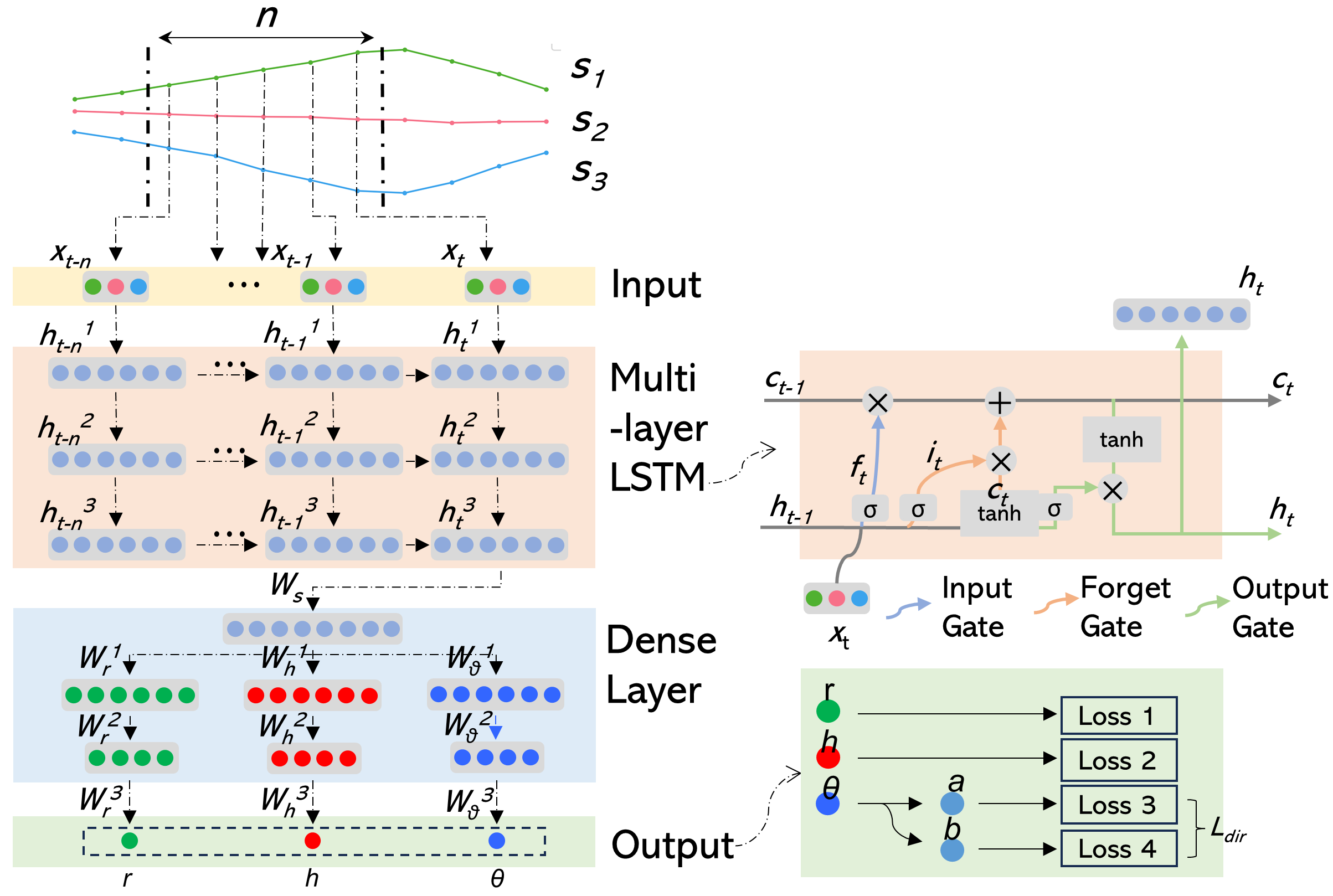
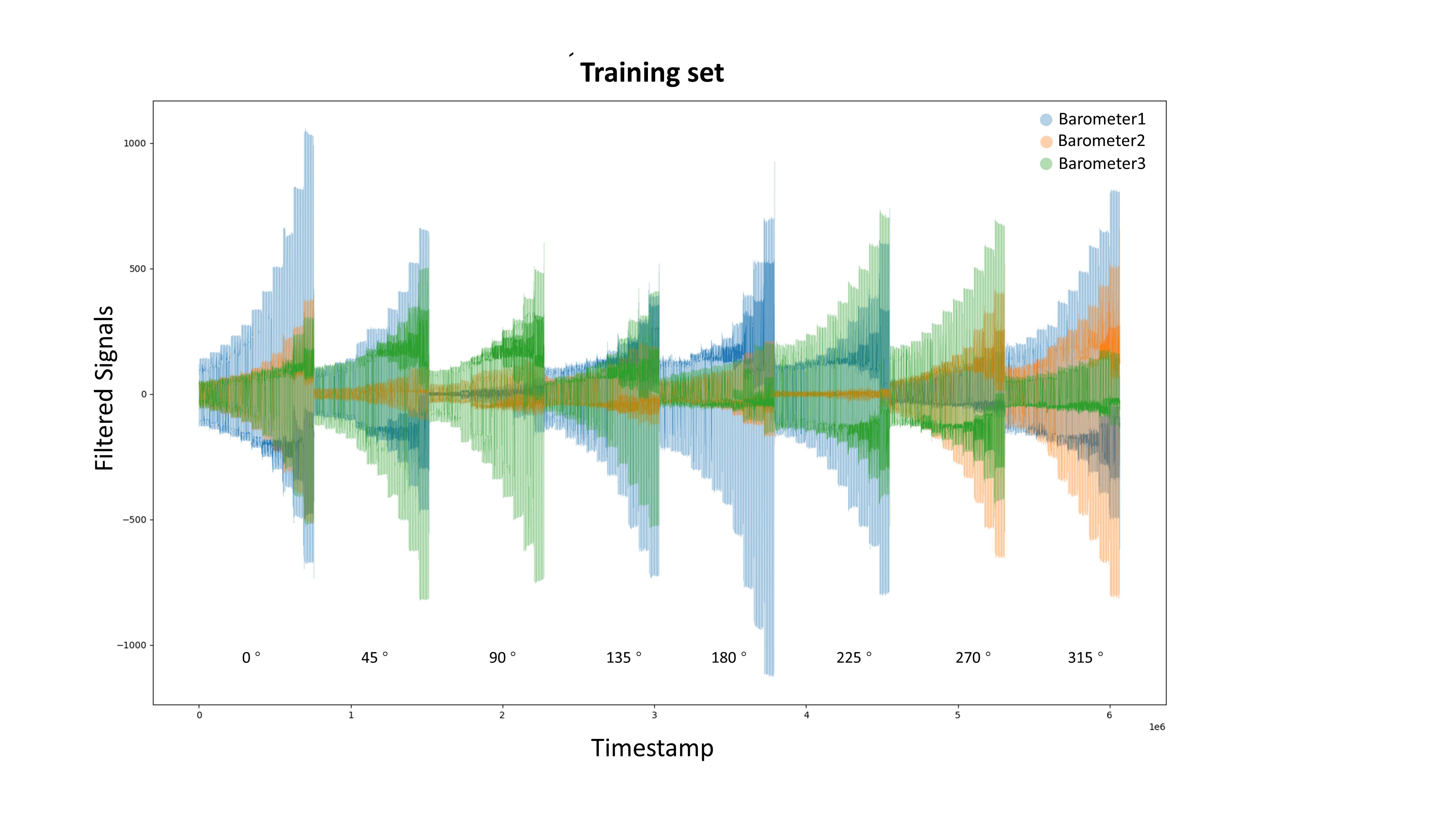
The dataset was split into training, validation, and test sets. The training set contains 6,068,046 frames, while both the validation and test sets have 1,504,834 frames each. The validation set is solely employed for hyperparameter selection. We show the training dataset as an example:
The training set was randomly shuffled in each epoch. All models were using the Adam optimizer. Below, we provide our optimal hyperparameters determined through the grid search method:
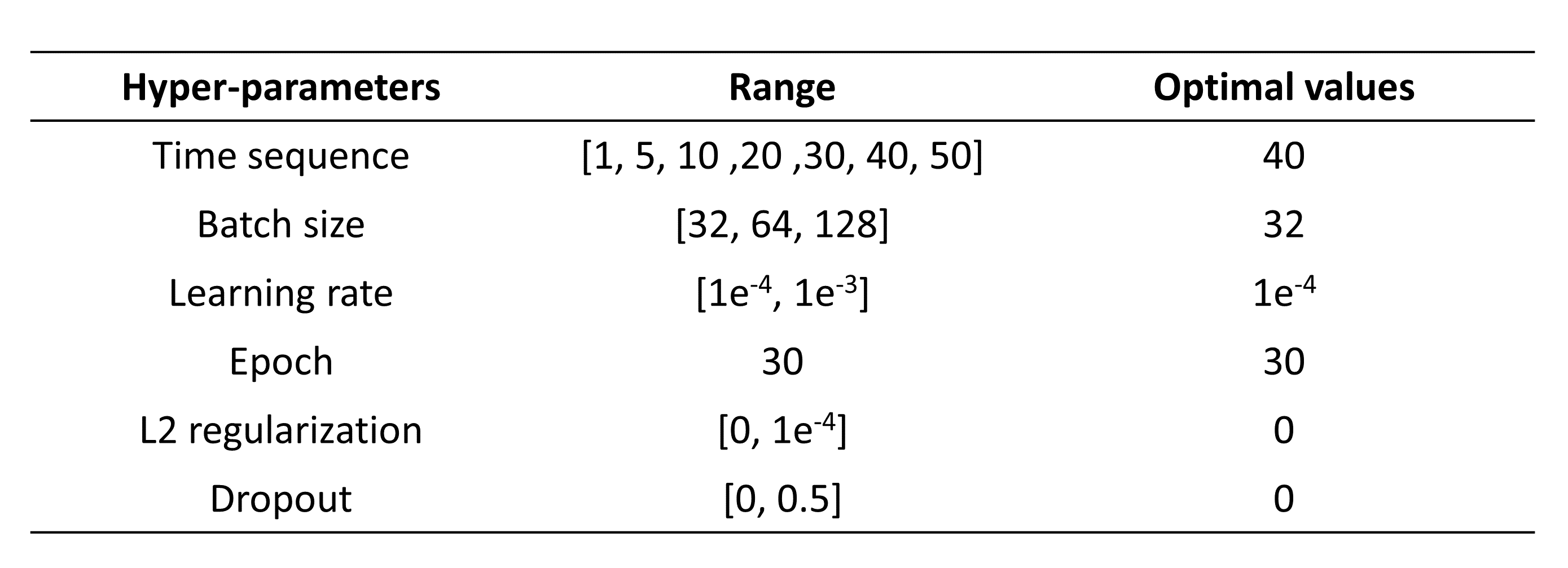
To train the model by our optimal hyper-parameters
python main.pyTo train the model by grid search method to find the optimal hyper-parameters
python main.py --time_sequence [your_setting] --batch_sizes [your_setting] --learning_rates [your_setting] --regularization_values [your_setting] --dropout_values [your_setting]python main.py -test --model_file your_file_nameWe also provide our model weights at best_model_save/best_model_ts_40_bs_32_lr_0.0001_reg_0_do_0.0_loss_0.1170.pt
To evaluate by our model weights
python main.py -test --model_file best_model_ts_40_bs_32_lr_0.0001_reg_0_do_0.0_loss_0.1170.ptIf you have any questions, feel free to contact us through email (C.Ye@tudelft.nl). Enjoy!
| Qty | Value | Footprint | References |
|---|---|---|---|
| 9 | 100nF | Capacitor_SMD:C_0402_1005Metric | C4, C5, C6, C7, C8, C9, C10, C11, C12 |
| 8 | TestPoint | TestPoint:TestPoint_Pad_D1.0mm | CSB1, CSB2, CSB3, GND, PWR, SCK, SDI, SDO |
| 6 | Conn_01x04_Male | Connector_PinHeader_1.27mm:PinHeader_1x04_P1.27mm_Horizontal | J1, J2, J3, J4, J5, J6 |
| 3 | BMP390 | BMP390L:XDCR_BMP390L | U3_1, U3_2, U3_3 |
| 1 | 10K | Resistor_SMD:R_0402_1005Metric | R2 |
| 1 | 10uF | Capacitor_SMD:C_0603_1608Metric | C3 |
| 1 | STM32F070F6Px | Package_SO:TSSOP-20_4.4x6.5mm_P0.65mm | U2 |
SunDevilRocketry/Flight-Computer
General purpose flight computer for high powered rocketry projects.


Ilikemining1/ESPWatchS3
ESP32-S3 based smartwatch with CrystalFontz 240x240 1.3in LCD.

katetriestocode/trailmap
this is the working version! (disclaimer: no antenna as it has not delivered yet, so manual gps coords insertion for now!)

WojtaCZ/telinksensor-hw
HW repository for TLSR8258 based temperature, humidity and pressure sensor

Afligh8/FlightController
A simple Plug and Play FLight Controller for Wings. Supports two motors with ESC, 6 PWM pins, SPI, I2C and Serials. Also 6 ports for servos and extra GPIO pins for debug and freelance.


bahrant/HAP-Electronics-
EDA files for a rocket flight computer. Resulting designs will be printed on a pcb and be flown on level 1 & 2 High Powered Rockets
It measures 20.8 × 18 mm and has 4 copper layers, 1.6 mm thick.
29 parts, built around the BMP390. The full list of its parts is on this page, with links to each part's symbol and footprint where PCBKit's library has them.
From the BioMorphic-Intelligence-Lab/Whisker-3D-Localization repository on GitHub, at the commit this page was made from: the board is PCB design/KICAD file/whisker.kicad_pcb and its schematic PCB design/KICAD file/whisker.kicad_sch. PCBKit opens the board in the browser, with nothing to install.
Its repository states no licence, so its author keeps all rights: ask BioMorphic-Intelligence-Lab before reusing the design.