
4 layers25 × 57.8 mm
 Amp-Lab-at-VT/website4
NextJS Amp-Lab Webapp
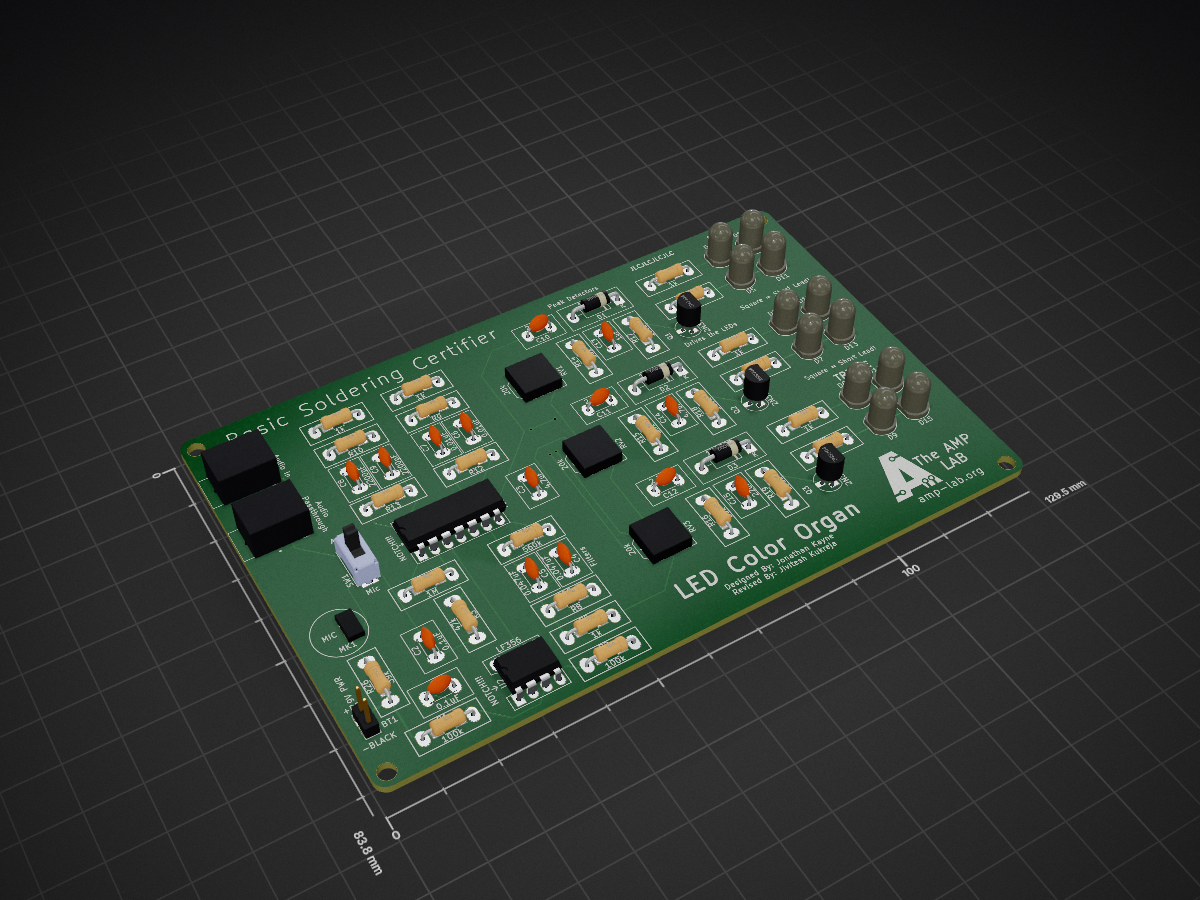
LED Color Organ is an open-source printed circuit board by Amp-Lab-at-VT, from the Amp-Lab-at-VT/website repository on GitHub. It is a 2-layer board of 129.5 × 83.8 mm with 74 parts on 48 nets, routed with 276 tracks and 4 vias.
It is built around the STX-3000. Its parts include 26 resistors, 15 capacitors, 15 diodes, 3 transistors and 2 ICs.
For more information on the development of this website, see DEVNOTES.md. In this file I have included the specifics on how this website works, where to find the information you need, and how to learn how to develop on this site. This will be crucial if this website ever fails. Good luck! - Henry Forsyth
This is a Next.js project bootstrapped with create-next-app.
First, run the development server:
npm run dev
# or
yarn dev
# or
pnpm dev
Open http://localhost:3000 with your browser to see the result.
You can start editing the page by modifying pages/index.tsx. The page auto-updates as you edit the file.
API routes can be accessed on http://localhost:3000/api/hello. This endpoint can be edited in pages/api/hello.ts.
The pages/api directory is mapped to /api/*. Files in this directory are treated as API routes instead of React pages.
This project uses next/font to automatically optimize and load Inter, a custom Google Font.
To learn more about Next.js, take a look at the following resources:
You can check out the Next.js GitHub repository - your feedback and contributions are welcome!
The easiest way to deploy your Next.js app is to use the Vercel Platform from the creators of Next.js.
Check out our Next.js deployment documentation for more details.
| Qty | Value | Footprint | References |
|---|---|---|---|
| 12 | LED | ColorOrgan:LED_D5.0mm_handsolder | D4, D5, D6, D7, D8, D9, D10, D11, D12, D13, D14, D15 |
| 9 | 1k | ColorOrgan:R_Combo | R5, R6, R7, R20, R21, R22, R23, R24, R25 |
| 5 | 100k | ColorOrgan:R_Combo | R1, R2, R17, R18, R19 |
| 4 | 39k | ColorOrgan:R_Combo | R14, R15, R16, R26 |
| 3 | 1N4002 | ColorOrgan:D_DO-41_SOD81_P10.16mm_Horizontal_HandSolder | D1, D2, D3 |
| 3 | 2.2uF | ColorOrgan:C_Disc_D4.3mm_W1.9mm_P5.00mm_Handsolder | C10, C11, C12 |
| 3 | 20k | ColorOrgan:POT_Bourns_3306F | RV1, RV2, RV3 |
| 3 | 2N3904 | Package_TO_SOT_THT:TO-92_HandSolder | Q1, Q2, Q3 |
| 3 | 560k | ColorOrgan:R_Combo | R11, R12, R13 |
| 3 | 680 | ColorOrgan:R_Combo | R8, R9, R10 |
| 2 | 0.0022uF | ColorOrgan:C_Disc_D4.3mm_W1.9mm_P5.00mm_Handsolder | C8, C9 |
| 2 | 0.01uF | ColorOrgan:C_Disc_D4.3mm_W1.9mm_P5.00mm_Handsolder | C6, C7 |
| 2 | 0.047uF | ColorOrgan:C_Disc_D4.3mm_W1.9mm_P5.00mm_Handsolder | C4, C5 |
| 2 | 0.1uF | ColorOrgan:C_Disc_D4.3mm_W1.9mm_P5.00mm_Handsolder | C1, C2 |
| 2 | 4.7uF | ColorOrgan:C_Disc_D4.3mm_W1.9mm_P5.00mm_Handsolder | C3, C14 |
| 2 | STX-3000 | STX-3000:STX3000 | J1, J2 |
| 1 | 1M | ColorOrgan:R_Combo | R4 |
| 1 | 1uF | ColorOrgan:C_Disc_D4.3mm_W1.9mm_P5.00mm_Handsolder | C13 |
| 1 | 22uF | ColorOrgan:C_Disc_D4.3mm_W1.9mm_P5.00mm_Handsolder | C15 |
| 1 | 47k | ColorOrgan:R_Combo | R3 |
| 1 | Battery | ColorOrgan:PinHeader_1x02_P2.54mm_Vertical_Battery | BT1 |
| 1 | LF356 | ColorOrgan:DIP-8_labeled | U2 |
| 1 | LOGO | LOGO | G*** |
| 1 | Mic | ColorOrgan:CUI_CMA-6542PF | MK1 |
| 1 | SW_SPDT | ColorOrgan:SW_OS102011MS2QN1 | SW1 |
| 1 | TL074 | ColorOrgan:DIP-14_labeled | U1 |
The 70 most common of 74 parts.


microchip-pic-avr-examples/pic16f56q71-audio-light-show-mplab-mcc
An audio-reactive light show driven by the Q71's analog and DMX capabilities.

afcaff/opamp-amp
Audio preamp with adjustable gain and Baxandall bass/treble tone control, built on a TL072 with a 15V single supply.


davw4453/Tube-Amplifier-Project
This is a vacuum tube amplifier with modular input modules to provide for different audio source methods. This project was designed for my captsone project at CCSU.

LSDRM/DualPressure-Thermocouple_forVMCGUI
A customized DAQ board through UART protocol, embeding two pressure sensors and one thermocouple. Has been developed to be used with VMCGUI.

hackclub/OnBoard
💡 Join 1,000 teenagers and make your first PCB with a $100 grant!

CRImier/MyKiCad
My KiCad boards. Can't be bothered uploading individually anymore, so here you go.

Teslafly/Dead-OpenBMS-dead
A scalable, open source battery management system
It measures 129.5 × 83.8 mm and has 2 copper layers, 1.6 mm thick.
74 parts, built around the STX-3000. The full list of its parts is on this page, with links to each part's symbol and footprint where PCBKit's library has them.
From the Amp-Lab-at-VT/website repository on GitHub, at the commit this page was made from: the board is docs/solder_board_files/Led Color Organ/LED Color Organ.kicad_pcb and its schematic docs/solder_board_files/AMP Ruler/AMP_Ruler-LT1370_24feb2017.kicad_sch. PCBKit opens the board in the browser, with nothing to install.
Its repository states no licence, so its author keeps all rights: ask Amp-Lab-at-VT before reusing the design.