2 layers83.3 × 65.3 mm
SimonShield
github-linguist/linguist
Language Savant. If your repository's language is being reported incorrectly, send us a pull request!
46 parts14kMIT

 94k/stroem_hardware6
stroem PCB and plates
Stroem is an open-source printed circuit board by 94k, from the 94k/stroem_hardware repository on GitHub, published under the WTFPL licence. It is a 2-layer board of 95.3 × 85.7 mm with 46 parts on 43 nets, routed with 281 tracks and 2 vias.
Its parts include 21 switches, 20 diodes, 2 connectors and 1 IC. It belongs with the AVR (ATmega, ATtiny) boards of this library.
This repository contains the kicad and gerber files for the ström keyboard. The PCB and plates are below 100mm x 100mm. The ström is a split keyboard with 20 column staggered keys on each half.
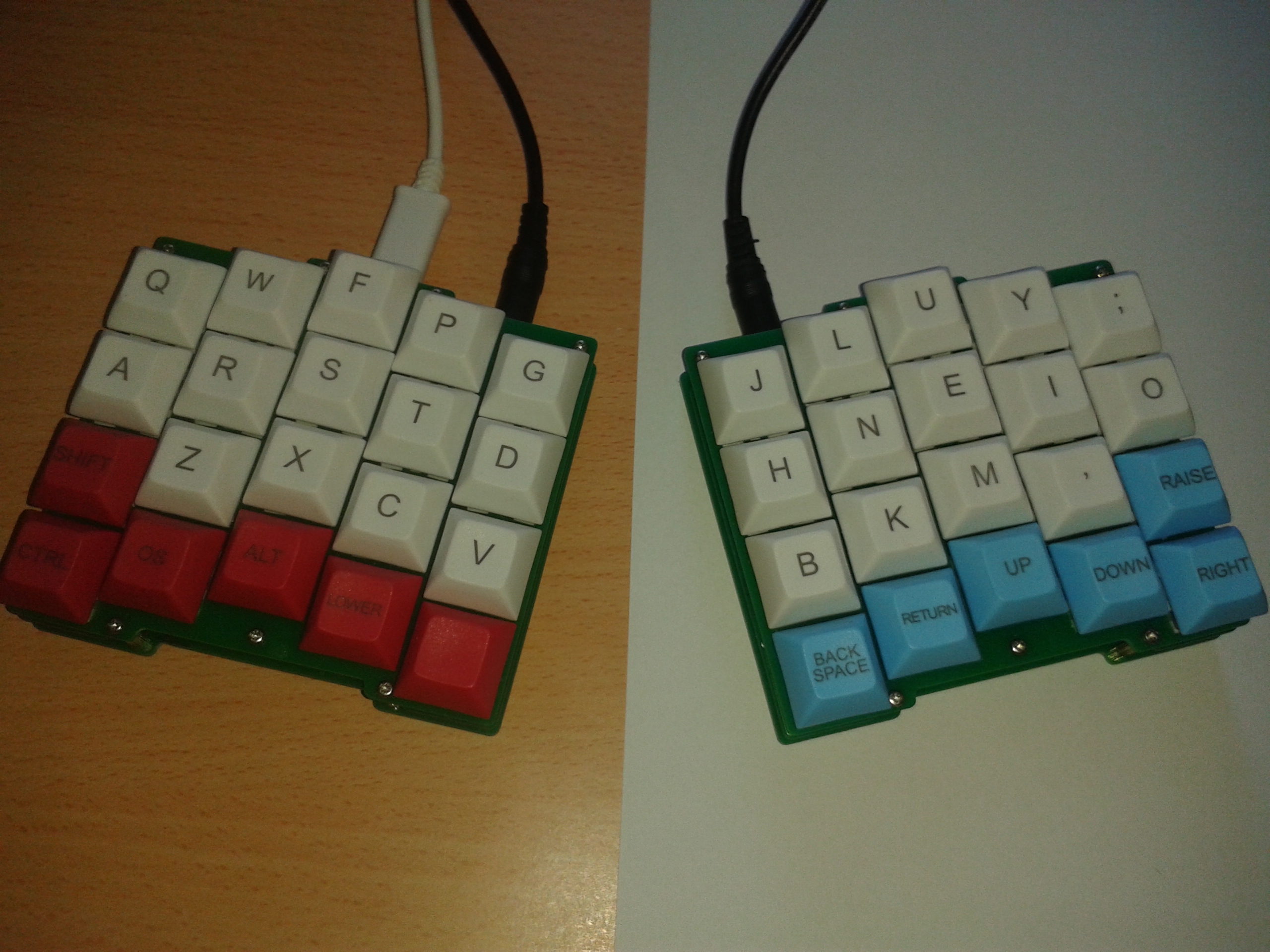
The PCB supports through hole diodes as well as 0805 diodes.
The ström is assembled in a similar fashion as most sandwich style keyboards such as the Let's Split or the Gherkin. Unlike the Let's split however, the PCB is not invertible, instead it offers two potential footprints for the TRRS jack with the Pro Micro in between, the ström also doesn't require any jumper settings. The Pro Micro is mounted with the USB towards the PCB on both sides to save space.

By default the ström uses the QMK serial connection to communicate between the two halves, although either I2C support or shared RGB backlighting can be added.
I2C has not been tested but should generally be working, follow the instructions below.
In order to use I2C, Pin 2 (SDA) on the Pro Micro has to be connected to the dormant trace in the TRRS connection, a pad to do so is provided as "DT2" right next to Pin 2, simply jump from the pin to the pad with a short wire.
Additionally I2C requires a 4.7kΩ pull-up resistor to each data line, the best place to add them is one of the empty TRRS jack footprints. VCC is connected to the right topmost pad, below is DT2 and the other data trace DT1 is the bottommost pad on that side, the single pad on the left side is GND. Simply use a SMD resistor between VCC and DT2 and solder the legs of a through hole resistor between VCC and DT2.

Use a 3 trace RGB strip, tap DT2, VCC and GND to propagate the color to the other half. Use either pin 9 or pin 10 on the pro micro as RGB pin.
The ström supports QMK. You can use a flat screw driver to short RST and GND instead of soldering a switch on SW1.
| Qty | Value | Footprint | References |
|---|---|---|---|
| 20 | D | keyboard_parts:D_SOD123_axial | D1, D2, D3, D4, D5, D10, D11, D12, D13, D14, D15, D16, D17, D18, D19, D20 +4 |
| 20 | KEYSW | Keyboard:CHERRY_PCB_100H | K1, K2, K3, K4, K5, K10, K11, K12, K13, K14, K15, K16, K17, K18, K19, K20 +4 |
| 2 | Audio-Jack-4 | Connectors:PJ320D_3.5mm_Jack | J1, J2 |
| 1 | ProMicro | keyboard_parts:Pro_Micro_fixed | U1 |
| 1 | SW_Push | Buttons_Switches_SMD:SW_SPST_TL3342 | SW1 |
| 1 | TEST | Measurement_Points:Test_Point_Keystone_5015_Micro-Minature | DT2 |
The 45 most common of 46 parts.
It measures 95.3 × 85.7 mm and has 2 copper layers, 1.6 mm thick.
46 parts. The full list of its parts is on this page, with links to each part's symbol and footprint where PCBKit's library has them.
From the 94k/stroem_hardware repository on GitHub, at the commit this page was made from: the board is kicad/stroem.kicad_pcb. PCBKit opens the board in the browser, with nothing to install.
Its repository publishes it under the WTFPL licence: you may reuse it on that licence's terms (keep the author's notice, and for a copyleft licence share your changes alike).
github-linguist/linguist
Language Savant. If your repository's language is being reported incorrectly, send us a pull request!

byrantech/laptop
anyon_e, a highly integrated, high end, open source laptop. Attempt the impossible.

VoronDesign/Voron-Hardware
Cool Hardware designed by the Voron Design group


hackclub/OnBoard
💡 Join 1,000 teenagers and make your first PCB with a $100 grant!


OLIMEX/DIY-LAPTOP
Do It Yourself Open Source Hardware and Software Modular Hacker's Friendly Laptop